


Creating well-designed educational environments is essential to promoting academic success, social integration, and overall well-being for students who are Deaf, deaf-blind, hard of hearing, blind, or have physical disabilities. Prioritizing inclusive design principles not only enhances the learning experience but also demonstrates respect and understanding for all users.
Understanding “Deaf” with a Capital “D”
The term Deaf, when capitalized, refers to individuals who identify as part of the Deaf community and culture, not merely as having a hearing loss. Many culturally Deaf individuals do not identify as “hard of hearing” and do not view deafness as a disability. This distinction is crucial in shaping environments that are inclusive and respectful of identity, culture, and language — especially American Sign Language (ASL).
The Problem with Current Educational Design
While many new state-funded schools for the Deaf and blind have been constructed in recent years, a significant number fall short in supporting student learning and teacher effectiveness. These inadequacies stem from poor architectural programming and environmental design that neglect the unique needs of Deaf and hard of hearing learners.
Teachers and counselors report feeling undervalued and disrespected due to ineffective classroom layouts, poor acoustic management, and inadequate space for teaching tools. These design failures contribute to persistently low literacy levels — often averaging at or below 4th-grade reading level —despite new facilities. This disconnect highlights a growing urgency for architects to place Deaf Education Design at the forefront of their planning and programming efforts.
The Role of Deaf Education Design
Designing schools for Deaf and hard of hearing students is not just about accessibility — it’s about optimizing spaces for visual communication, sensory awareness, and inclusive learning.
Key Design Principles:
1. Programming and Site Analysis
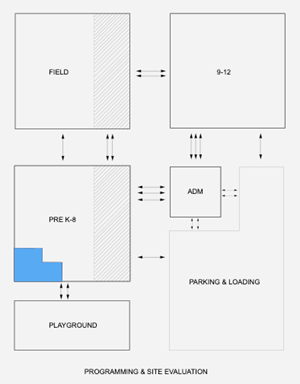
Before beginning any design, architects must engage in programming — a structured process of gathering and analyzing data to define the design problem. (See Diagram 1)
The Five Steps of Programming :
- Goals – Gather feedback from Deaf stakeholders about what is not working in the current educational program.
- Facts – Assess existing conditions and determine what must change to meet future needs.
- Concepts – Collaborate with Deaf architects and educators to develop design strategies (see Diagram 2).
- Needs – Analyze how much space is required and determine quality standards.
- Problems – Identify environmental or spatial issues in the current building that hinder learning (see Diagram 3).

2. Acoustics and Electromagnetic Interference
Acoustics matter — even for Deaf students. Many use hearing aids or cochlear implants, which can be affected by reverberation and electromagnetic (EM) interference. Minimizing background noise and EM fields from building systems is essential to maximize the effectiveness of assistive hearing devices.
3. Deaf Sensory Reach and Visual Accessibility
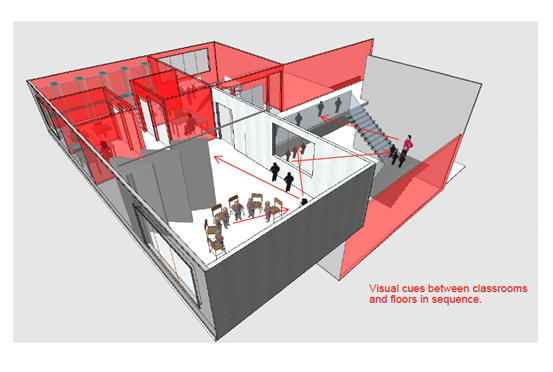
The concept of Deaf Sensory Reach refers to extending spatial awareness through visual cues, openness, and sightlines. Since Deaf students rely heavily on sight, classrooms must:
- Promote unobstructed visibility between teachers and students.
- Use circular seating arrangements to support group discussions in ASL.
- Provide ample lighting that avoids glare and harsh shadows.
4. Hearing Devices and Spatial Compatibility
Various hearing technologies — such as behind-the-ear (BTE) aids, bone conduction devices, and cochlear implants — have different spatial needs. Classrooms should be designed to:
- Reduce interference from wireless devices.
- Allow for proper use and maintenance of assistive technologies.
- Integrate compatible tech like real-time captioning, interactive whiteboards, and video relay services.


5. Deaf Proxemics and Spatial Flow
Proxemics refers to the study of personal space and physical proximity in communication. In Deaf culture, visual communication drives how space is used:
- Hallways, open areas, and shared spaces should support visual connectivity through windows, mirrors, and transparent walls (see Figure 5).
- Flexibility in spatial design allows for various group sizes and teaching methods (Figure 6).

6. Lighting and Visual Clarity
Proper lighting is critical for seeing facial expressions and hand movements. Design should emphasize:
- Natural daylight, where possible
- Glare-free artificial lighting to maintain consistent visibility (see Figure 7)
The Case for Inclusive Design in Deaf Education
When Deaf educational advisors are integrated into the design team, educational environments can be transformed into supportive, empowering spaces. Inclusive design doesn’t just benefit Deaf students — it uplifts teachers, improves academic outcomes, and fosters a culture of equity.
Key Takeaways:
- Inclusive design must be informed by Deaf culture and language.
- Environmental features like sightlines, acoustics, lighting, and spatial arrangement are not optional — they’re essential.
- Collaboration with Deaf professionals is vital to ensuring authenticity and usability.
Conclusion
Designing for Deaf and hard of hearing students is a specialized field that requires empathy, cultural knowledge, and architectural expertise. By embracing Deaf Education Design principles, architects and educators can co-create environments that truly serve all learners. In doing so, we not only improve educational outcomes but also affirm the dignity, identity, and full participation of Deaf individuals in society.