


For many learners, especially neurodivergent students who experience sensory input more intensely or process information differently, this gap between “I can’t start” and “I know what to do next” is the difference between a functional school day and a constant sense of failure. This article looks at that gap through the lens of self-regulated learning and emotion regulation and asks what it would mean to design learning environments that actively help students manage both.
A seventh grader arrives at their first class of the day already tired and anxious from an uncomfortable interaction in the hallway. The classroom is loud, the directions are fuzzy, and their phone is buzzing in their backpack. In one version of this morning, they choose a seat away from the noisiest corner, notice their heart racing, take a deep breath, switch their phone to do-not-disturb, and rewrite the assignment into a few simple steps, reminding themself why getting this done matters. They still feel off, but they know what to do next and stay with the work.
In another version, the same student drops into the first open seat near the door, leaves their phone within reach, and never quite registers how overwhelmed they are. The background noise, notifications, and awkward hallway moment blur together; they miss half the directions, start late, and the task quickly feels both impossible and pointless. Their intelligence has not changed between these two mornings. What changes is how motivated they feel and how well they are able — and allowed — to use their emotions and their physical environment to organize an approach to learning in that moment, and that shift can shape their performance as much as any measure of raw ability.

The Importance of Student Self-Regulation
Student self-regulation refers to the ability to manage one’s thoughts, emotions, and behaviors in ways that support learning and goal attainment. The Coalition for the Advanced Understanding of School Environments (CAUSE) Post-Occupancy Evaluation Tool measures two facets of student self-regulation that are especially relevant to the design of learning environments: academic self-regulation and emotion regulation.
Academic self-regulation describes how students plan and manage their learning, through strategies such as organizing materials, planning work, monitoring progress, and making adjustments in response to feedback. Emotion regulation describes how students navigate the feelings that arise while they learn, by staying motivated, rebounding from setbacks, and using effective strategies to manage stress, sensory overload, or frustration.
Together, these skills allow students to guide their actions, maintain enough focus to move forward, and adapt to challenges in order to reach academic goals.
The CAUSE post-occupancy evaluation tool adapts Academic Self-Regulation items from Usher and Pajares’ Self-Efficacy for Self-Regulated Learning scale and Emotion Regulation items from Roth and colleagues’ Emotion Regulation Inventory, both long-established measures with demonstrated predictive power for students’ academic performance, persistence, and emotional well-being. In practice, a student who breaks a project into manageable parts, uses a checklist, or decides to revisit confusing material later is exercising academic self-regulation. A student who takes a short sensory break, asks for clarification rather than pretending to understand, or reframes a poor grade as information rather than as a personal failure is engaging in emotion regulation.

Transforming Belief into Performance
Research on academic self-regulation and self-efficacy is remarkably consistent – how students manage their own learning strongly predicts how they perform. Barry Zimmerman, building on Albert Bandura’s work, notes that students who believe they can succeed participate more readily, work harder, persist longer, and have fewer adverse emotional reactions when they encounter difficulties than peers who doubt their capabilities. Drawing on four decades of research, Schunk and DiBenedetto show that when students truly believe in their ability to learn, their brains work more efficiently. Such confidence enables students to cut through distractions and solve problems faster than students who doubt themselves. Confident students may also set more challenging goals for themselves and use strategies to effectively pursue those goals. Over time, this combination of belief and behavior produces higher academic achievement across a range of indicators.
Emotion regulation exerts a parallel influence. Reinhard Pekrun’s work demonstrates that emotions are not just a backdrop to learning — they influence how students approach it. Positive emotions such as interest and enjoyment are associated with flexible, creative, and deep learning strategies like elaborating on new material, connecting ideas across topics, organizing information meaningfully, and engaging in critical thinking. In contrast, persistent, unmanaged negative emotions — such as anxiety and shame — tend to narrow students’ focus and push them toward less-effective, surface-level strategies like rote rehearsal, avoidance, or giving up. If students feel constantly on edge, criticized, or out of place, deep learning becomes less likely even when they are intellectually capable.
Physical Space as a Co-Regulator
Before we design learning spaces for self-regulation, we must acknowledge the baseline physical parameters for what makes a learning environment comfortable. Decades of research on acoustics, lighting, seating layout, and material organization in classrooms show that these ambient conditions shape students’ ability to manage sensory input and stay engaged. This is especially true for neurodivergent learners. If the ambient conditions are chronically overstimulating, even the best self-regulation strategies are working uphill. Once that baseline is reasonably supportive, the more interesting question becomes: how can students actively manipulate and use their surroundings to do the work of self-regulated learning and emotion regulation?
One way learning spaces can act as co-regulators is by giving students places to externalize their thinking. When walls, tables, and mobile boards are treated as shared thinking surfaces, students can spread out ideas, cluster related concepts, and physically reorganize information as they elaborate on new material or connect topics. In a similar way, clearly differentiated zones for quiet focus, collaborative problem-solving, and informal discussion let students choose spaces that match the attentional demands of a task and their own regulatory needs.
If the classroom design encourages students to ask for help, strategic help-seeking and emotional reset can become ordinary parts of the room’s circulation pattern. Locating a small help desk or side station where students can confer briefly with a teacher, or with each other, lowers the social cost of asking for clarification. Likewise, embedding a few small, supervised reset spots like a soft chair tucked into a corner, a short pacing loop along a back wall, or a perch near a window, signals that taking a brief break, breathing, and then re-engaging is an acceptable strategy.
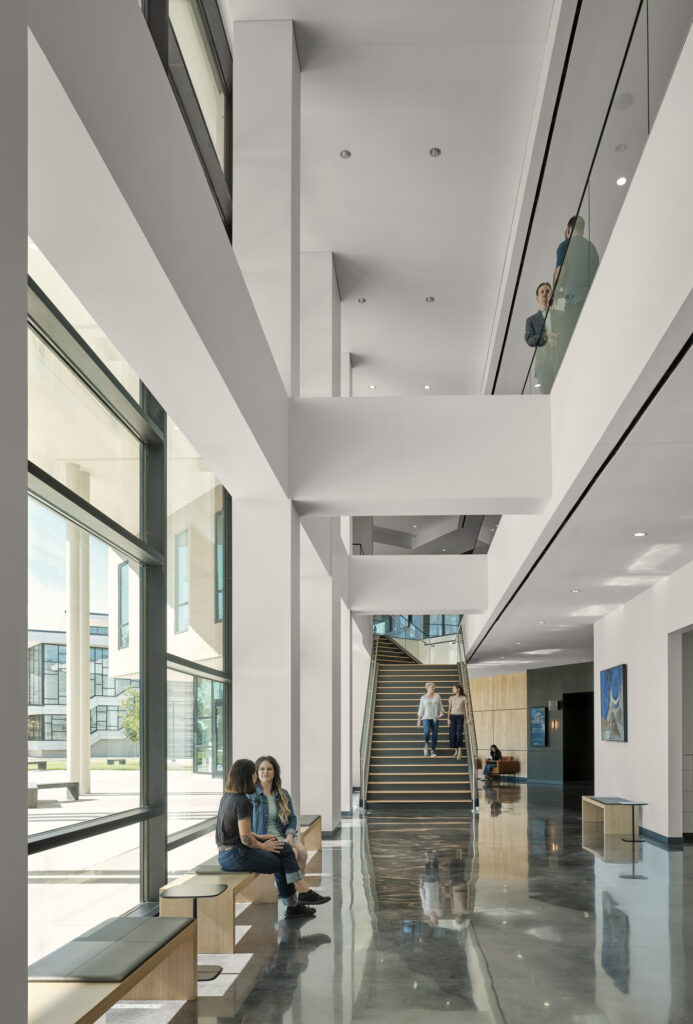
These design moves are strongly aligned with what self-regulated learning and academic-emotion research say students should be doing, but it is important to recognize that the specific causal links between individual design features and measured self-regulation or emotion-regulation outcomes in K–12 are still emerging. Establishing those links matters because design decisions lock in conditions for decades at a time, shaping the daily experience of hundreds or thousands of students, and compete with other investments for limited resources. For now, these strategies are best understood as theory-driven, practice-informed hypotheses that tools like CAUSE can begin to test more systematically over time.
Adoption of the CAUSE tool offers a meaningful step toward developing a stronger, evidence-based understanding of how learning environments affect academic and emotion self-regulation. By moving beyond intuition and aesthetic preferences, schools and design firms can build an evidence base that links student outcomes to specific design strategies. The CAUSE User Guide offers practical guidance for administering student surveys, with further iterations providing feedback to refine and validate these connections. For educators, designers, and district leaders committed to evidence-based learning environments, the call to action is clear: use the tool, share what you learn, and help turn everyday design choices into tested strategies for strengthening students’ capacity to manage their thinking and emotions in school.