

If you close your eyes and picture a school restroom, chances are the image comes quickly: a row of toilet stalls, possibly urinals separated by small partitions, and sinks with mirrors on the wall. This template hasn’t changed much in decades. It’s so familiar that we rarely pause to ask if it’s worth repeating. But here’s the truth: the multi-user restroom model isn’t just outdated — it’s bad design.
For generations, school restrooms have been designed for efficiency and cost savings, not for students’ real needs. And that design choice has consequences: restrooms are some of the least safe, least supervised, and least dignified spaces on campus. Recent legislation in states like Texas has reignited debates about who belongs in which restroom. These laws focus narrowly on regulating people — and they sidestep a bigger, more fundamental problem: the multi-user design itself. If we want safer, healthier, and more respectful schools for every student, it’s time to let go of the old restroom model once and for all.
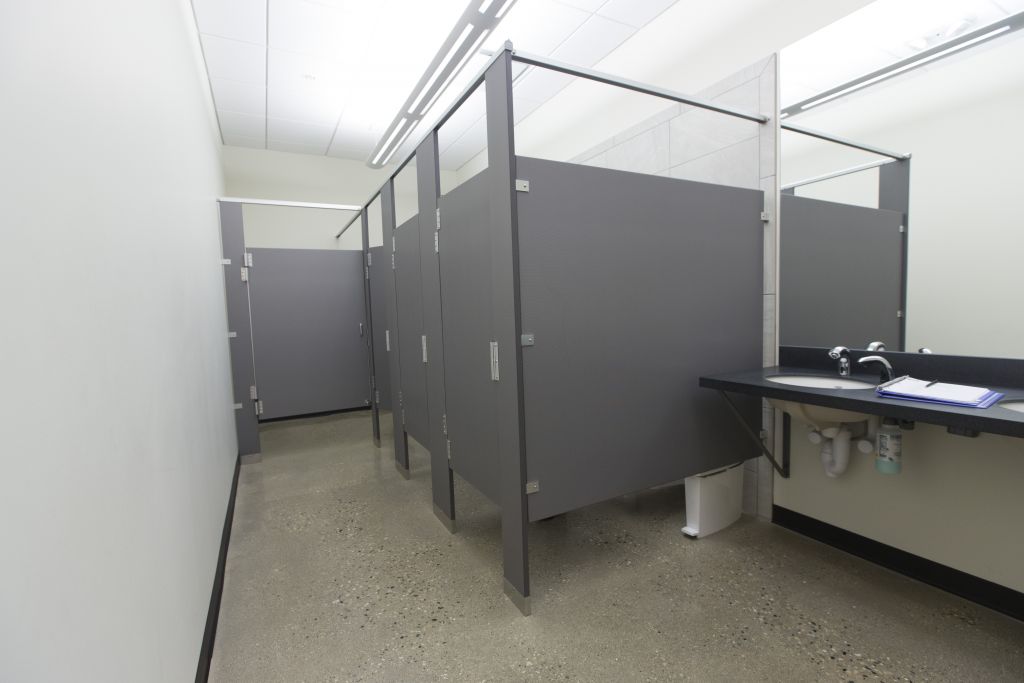
School restrooms were never designed with care or intention for the child’s experience. They were designed to move students in and out quickly, at the lowest possible cost of construction. That prioritization of efficiency over humanity has been baked in since the inception of this design. Historian Peter C. Baldwin captured the impact of this reality in his essay Public Privacy: Restrooms in American Cities, 1869 to 1932, writing, “Concerns about inadequate privacy, safety and cleanliness discouraged many people — particularly women — from using public comfort stations.” A century later, our schools are still wrestling with the same problems using the same design.
At the core of this issue is a basic misunderstanding: not all restroom functions are created equally. There are private functions, such as changing clothes and using the toilet or urinal, and non-private functions, such as washing hands, adjusting clothing, or grooming. Multi-user restrooms treat every function as private. That means everything happens behind closed doors, out of sight from adults. The result is a design that creates blind spots, invites misconduct, and complicates supervision.

Because every inch of a multi-user restroom is considered private, schools cannot place cameras inside or assign staff to watch. The message to students is clear: once you cross the threshold, you’re in a zone where adults can’t see — and students notice. Unsupervised restrooms quickly become hubs for behavior that wouldn’t be tolerated in a hallway or classroom: bullying, harassment, vaping, drug sales, even self-harm. It’s not that schools don’t care — it’s that the design makes prevention, intervention, and mitigation unnecessarily difficult.
Students also face daily embarrassment. Thin partitions and poor acoustics mean everyone hears when someone passes gas, uses feminine hygiene products, or has a bowel movement. For children navigating adolescence, that humiliation sticks. Many avoid using the restroom altogether, risking discomfort or even health issues. Another challenge emerges from students congregating in restrooms for reasons unrelated to restroom use. For his entire K–12 career, my son refused to use the restroom outside of class time because he didn’t want to exit alongside students who were vaping and be “guilty by association.” When the built environment undermines supervision, dignity, and autonomy, schools waste a multitude of resources — and still fail to address the root issue.

When safety concerns arise, the instinct is often to respond with more rules, more exclusions, or harsher punishments. But rules do little to stop what happens in blind spots, and punishment after the fact doesn’t prevent harm before it occurs. Recent bathroom legislation has been framed as necessary to protect girls, yet the design itself continues to fail them. Bullying and harassment most often occur between peers of the same gender, in gender-segregated restrooms where students assume they won’t get caught. Embarrassment arises for all students when privacy is compromised. Vaping thrives in spaces where privacy is applied too broadly. As Baldwin noted in his article, women were the ones who felt most vulnerable in public comfort stations. The truth is, we’ve been doing women a disservice for more than a hundred years. If we truly want to protect them, let’s finally design for them — and when we do, all students benefit, including the ones at the center of recent legislation.
The multi-user restroom design needs to be phased out with every renovation or new construction project. It doesn’t align with shared values of safety, accountability, and respect. It doesn’t reflect the diversity of student needs — religious, cultural, developmental, or personal. And it doesn’t solve the problems to which it claims to respond. By contrast, single-user stall designs separate private and non-private functions. Students use the toilet in full privacy, then step out into a supervised, non-private space for handwashing and grooming. Adults can monitor the non-private activities while the private ones remain protected. The result is less bullying, less misconduct, more dignity, and greater peace of mind —for all students.

This is not a conversation about one group of children. It’s about every child who has ever been bullied in a restroom, avoided going all day out of embarrassment, or felt unsafe in an unsupervised zone. Students of faith who value modesty deserve facilities that honor their beliefs. Students with disabilities deserve spaces that accommodate their needs without compromising privacy. Trans and nonbinary students deserve safe, affirming access without being singled out. Every student deserves acoustic and visual privacy and freedom from physical or sexual harm. Abandoning multi-user restrooms once and for all is not about special treatment. It’s about creating a baseline of safety, respect, and dignity that benefits everyone.
Every space in a school, from classrooms to restrooms, has a role to play in helping students feel safe, supported, and ready to learn.
For generations, architects have been invited into conversations about safety only after inevitable harm has occurred — when the task is to repair, rebuild, and mitigate future damage. Yet the built environment holds enormous potential for prevention, where thoughtful design makes intentionally harmful behavior less likely to occur in the first place. Rethinking restroom design through this lens connects directly to the real challenges students and districts face every day. By relocating non-private functions into visible, supervised zones, the time students spend in truly private areas is dramatically reduced. The result is an environment that preserves privacy where it matters most and adds visibility, where appropriate, to strengthen safety and accountability.
This is where the profession must evolve next. The conversation about restrooms is not really about restrooms at all — it’s about whether design will continue to react to harm or begin to prevent it. Stakeholders can no longer afford to replicate patterns that put students at risk under the banner of efficiency. Architects and school leaders share the opportunity — and the responsibility — to use design itself as a preventive tool, creating spaces that reduce harmful behaviors and promote belonging by design, not by rule, and prioritize students over dollars.
The next article in this three-article series explores how this perspective translates into tangible standards through Five Phases Design — a model that incorporates all five phases of emergency management. This approach necessitates intentional design of every space — including awareness of unintended consequences — and addresses not only what is inevitable, but what can be prevented. Every space in a school, from classrooms to restrooms, has a role to play in helping students feel safe, supported, and ready to learn.