

With so much to process and so much pressure to achieve in today’s fast-paced, data-inundated world, the need to help students find balance is greater than ever. Designed to replace an existing facility originally built in 1955, the new Barton Elementary School doesn’t simply shift curriculum or pedagogy to prepare students for a healthy, fulfilling future. Instead, it uses the built environment as a tool to unlock future-ready learning. By combining a human-centered approach with technology-rich learning environments, Barton supports academic success while prioritizing well-being.
The design takes the Whole Child Approach, encouraging holistic student development by “ensuring each child is healthy, safe, engaged, supported, and challenged,” and shifting the educational focus from purely academic achievement to long-term growth and success (ASCD, 2007). Its combination of traditional, collaborative, and outdoor learning spaces grants autonomy to students as they progress through grade levels, encouraging the development of self-regulation and executive function.
The result is a school that embraces technology, nature, and intentional design to connect students with themselves, their peers, and their learning.
We didn’t set these priorities on our own. Through a robust process of visioning and discovery, we reached out for design input from the experts: students, teachers, and community members. The result is a school that embraces technology, nature, and intentional design to connect students with themselves, their peers, and their learning.
Planning, Discovery and Educational Visioning
The foundation for all project concepts was the district’s vision, led by Superintendent Magda Hernandez. Her top priority was to create state-of-the-art facilities that would redefine the design of education for all students. To understand what that would mean in practice, we implemented a visioning process tailored to the Barton project and the district’s goals. A series of guided questions helped stakeholders articulate what they wanted teaching, learning, and the built environment to look like. For example, should teachers remain in individual classrooms, or work within a network of learning spaces where students could choose which instructors they engaged with?
As part of this process, stakeholders also participated in an exercise that mapped their aspirations for pre-k through 5th grade learning along a spectrum, from guided and traditional approaches to autonomy and innovation. This collaborative activity provided clarity and direction, ensuring the design would reflect the district’s unique priorities.
Toward a Progression of Learning
The resulting design features a series of learning neighborhoods organized by age group. As students progress through these neighborhoods, they gain more access to collaboration space characterized by technology, flexible furniture, choice, and transparency that puts learning on display.
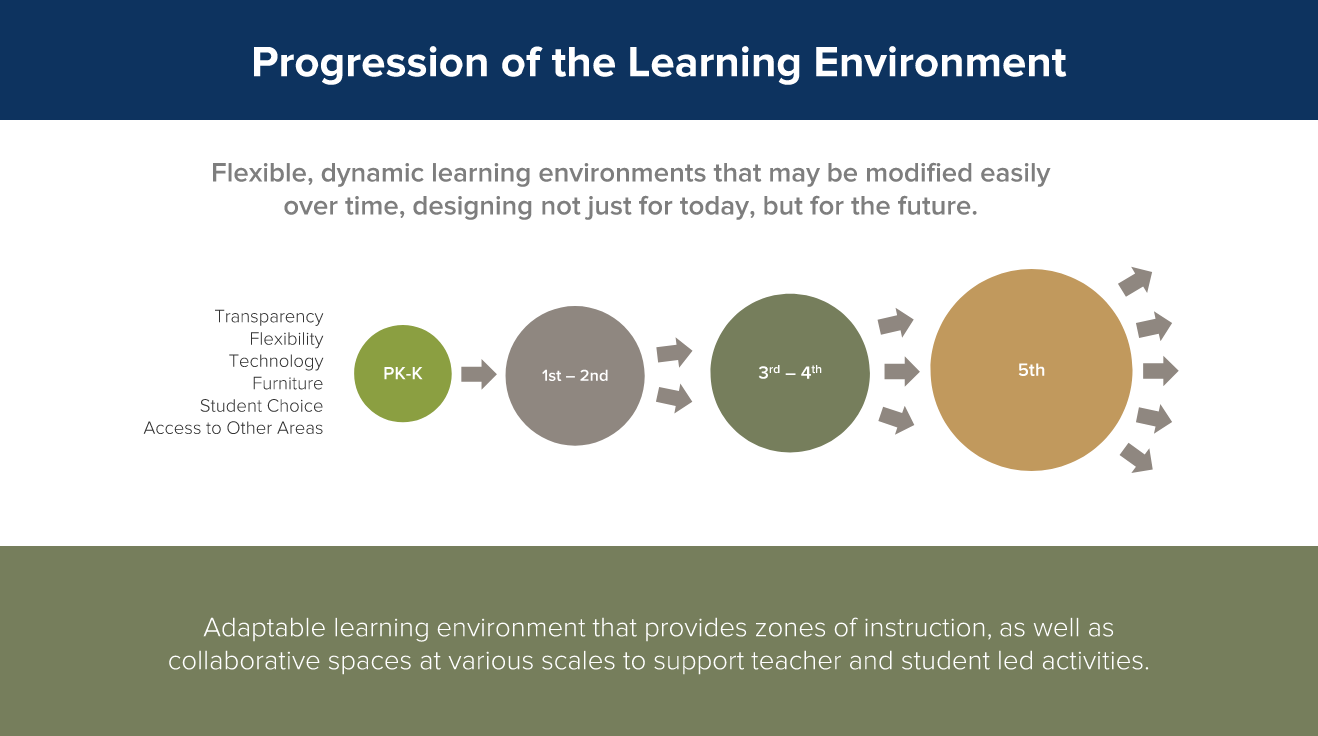
In pre-k and kindergarten, collaboration space is not adjacent to the classroom. Instead, it’s a destination. Students travel with teachers to these spaces, and once they arrive, the teachers remain to supervise.
As children move into 1st and 2nd grade, they don’t need direct supervision — a line of sight from teacher to student is sufficient. Collaboration spaces sit outside of instruction areas, which feature windows with sills that are slightly taller than the students. From their classrooms, teachers can monitor activity in the collaboration space, without creating a distraction for learners in either zone.

In 3rd through 5th grade, there’s full transparency: glass walls separate instructional spaces from a collaboration commons. Those walls also fold open, dissolving the traditional boundaries of a classroom, and creating a fluid connection between instructional and collaborative spaces.
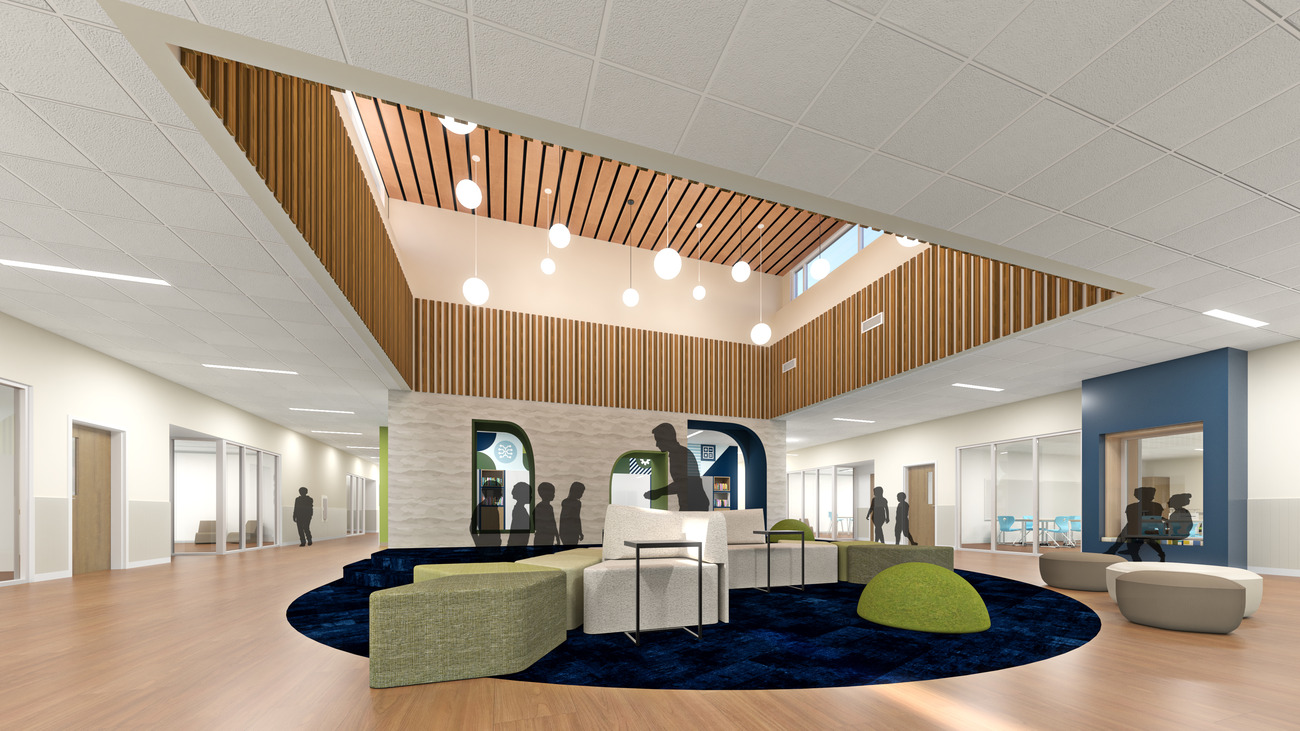
This flexibility empowers students with choice: Here, students know what work they need to get done, but they can complete that work with a peer, a teacher of their choosing, or by themselves. This design supports multiple learning modalities — collaborative, guided, and self-directed — within the same footprint, fostering autonomy while maintaining structure.

Connecting With Nature
Connecting students with themselves is not just about giving them autonomy, but also about connecting them with nature. Biophilic concepts thus became a foundational layer of the design. Our approach extends beyond the interior spaces, with the school opening safely and securely to seven outdoor learning areas: a grow garden next to the cafeteria, a reflection garden adjacent to the lobby and teacher lounge, an art garden, a STEM garden, a reading garden next to the library, a science garden, and a human sundial. Even the playground design and equipment were developed around nature-inspired concepts, fostering exploration and discovery. And though playgrounds across the district have traditionally featured primary colors, with district approval, our design introduces a fresh palette of natural hues, reinforcing the connection to the outdoors.

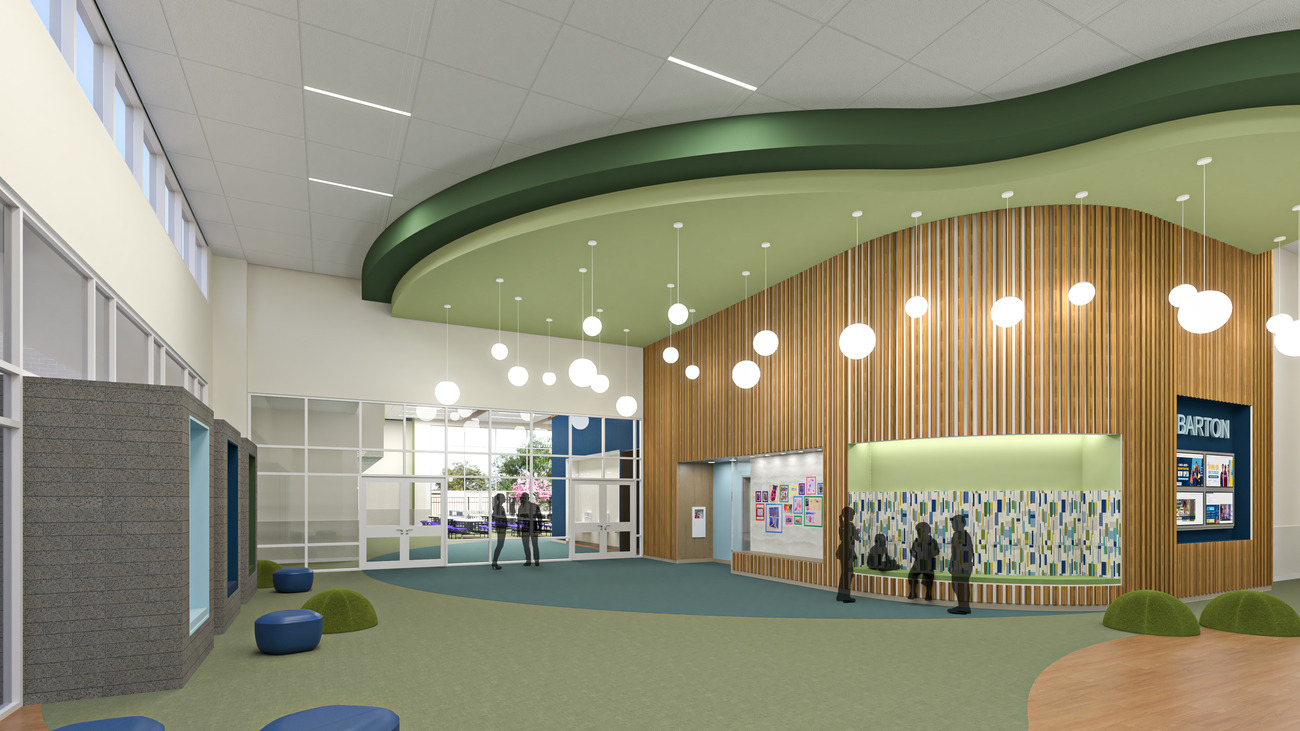
Inside the building, too, a natural palette, natural materials, and other biophilic elements continue the connection with nature to promote physical, mental, and emotional health. In the lobby and collaboration spaces, ottomans that look and feel like grassy mounds provide a biophilic seating option. Additional seating options, as well as a cutout of a tree and its leaves in one of the collaboration spaces, nod to natural shapes and forms. Wood finishes are prominent throughout, from the thin slats that make up the curved wall in the lobby, designed to resemble the trunk of a massive tree, to the planks on the underside of the library’s canopy.
Beyond what looks natural, biophilic features are also about what feels natural. Just as animals retreat into caves and other small spaces where they feel comfortable, nooks in the walls offer students places of refuge to work on the computer, read a book, or process their emotions.
Getting Fluent With Technology
With opportunities to both dig their hands into the soil and also gain fluency with high technology, Barton Elementary truly caters to the whole student. Not only is this STEM school integrated with the district’s computer science immersion program, it also features cutting-edge teaching tools.
Central among them is the immersive classroom, a transformative learning environment. Designed as a circular space, it features a nearly 360-degree projection surface paired with a sophisticated audiovisual system that creates a fully immersive virtual reality experience. This innovation gives educators and students the ability to transcend traditional learning boundaries. Imagine exploring the Amazon rainforest, hearing the sounds of wildlife, or traveling to the moon to study its surface. Students can experience different climate zones, observe fauna in their natural habitats, and engage with cultures across the globe — all without leaving the classroom. Beyond exploration, the system supports custom-designed instructional content, enabling teachers to adapt scenarios for any subject, from science to history, fostering deeper engagement and understanding. To maximize versatility, the space is also designed to function as a collaborative hub, supporting group projects and interactive learning sessions.
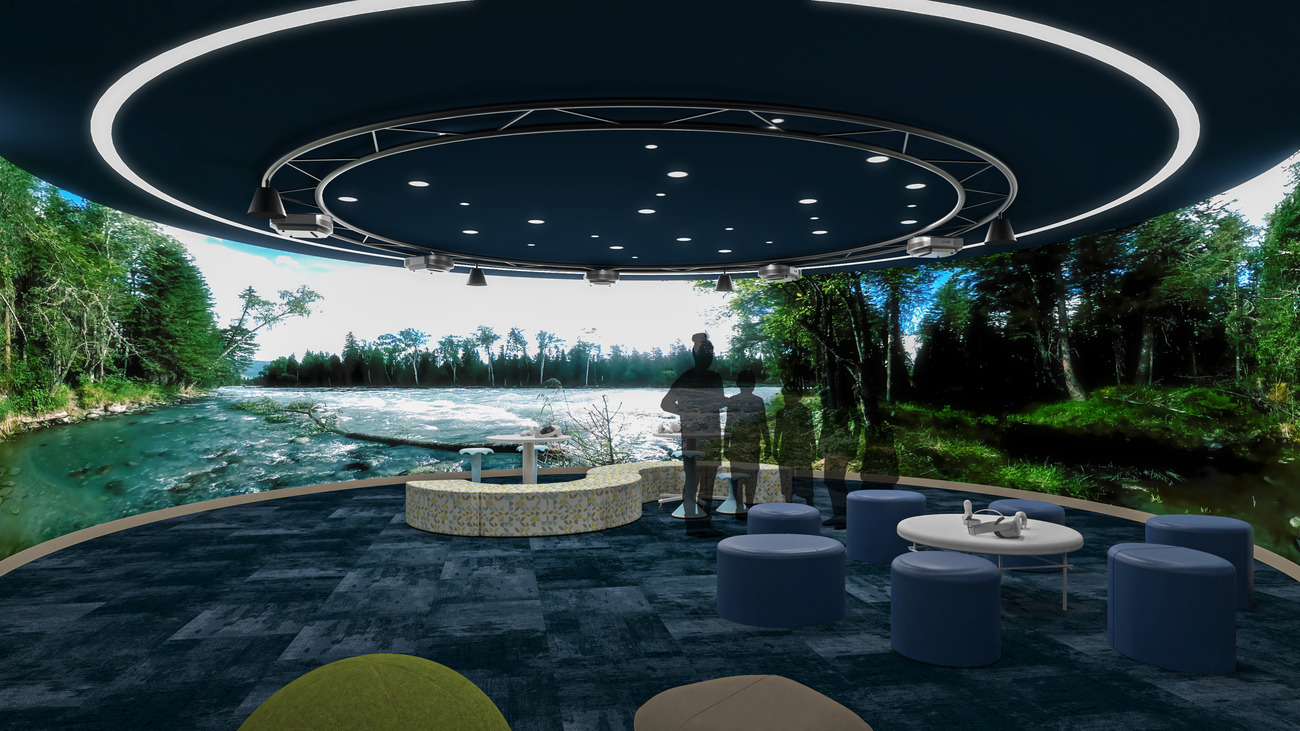
This immersive experience builds essential background knowledge, a critical factor in academic success. By providing rich, multisensory experiences, students make abstract concepts tangible and create mental models that strengthen comprehension and retention. They connect new information to prior knowledge, which enhances problem-solving and critical thinking. As educational psychologist David Ausubel famously stated, “The most important single factor influencing learning is what the learner already knows” (Ausubel, 1968). Strong background knowledge is directly linked to improved performance across subjects, and this space ensures equitable access to experiences that many students might otherwise never encounter. The immersive classroom space at Barton provides infinite possibilities and a powerful tool for elevating learning outcomes. A magic door in the 1st and 2nd grade collaboration space provides a similar immersive experience, playing a different video on a loop each time students open the door.
Next, in the gym is a LU system, an interactive audiovisual projector that allows students to interact with images. They can throw balls at numbers to add them together, touch shapes to identify them, or follow guided exercises displayed on the wall. It’s a tool that encourages movement, connecting movement to learning, and learning to well-being.
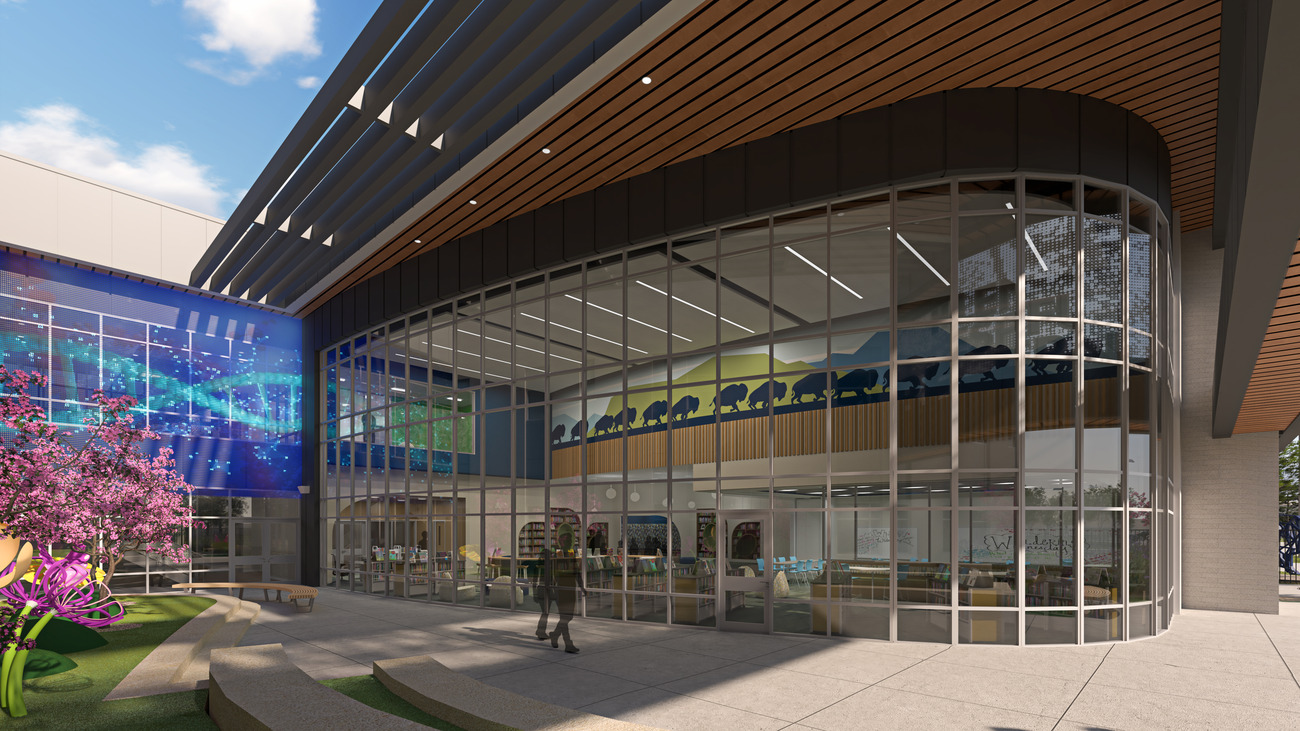
Finally, outside the library, a transparent LED media façade faces the reading garden. This innovative mesh system creates dynamic, large-scale visual displays. When active, it transforms the outdoor space into an immersive environment, blending the grounding presence of nature with the limitless possibilities of the digital world. When not in use, the façade serves as a sunshade, reducing direct solar exposure on the south-facing curtain wall and improving energy efficiency. Beyond its functional benefits, this feature opens opportunities for impactful presentations during the school day, as well as at night for PTA meetings and special events, making the space a true hub for learning and community engagement.
Every Space an Opportunity for Teaching and Connection
One of our primary goals was to imbue every space with intentionality. No matter where it is, or what its primary use, every space can be leveraged for teaching. Even the lobby, which already serves dual functions as the point of arrival and nexus of circulation, invites visitors to pause and learn. Expansive windows, curved surfaces, and the high point of an articulated ceiling transform what could have been just another flow-through zone into a welcoming gathering place. Even still, amid the open space, seating cubbies notched into the wall offer a quiet place for study, rest, or reflection.
Our intentional use of shape and proportion continues throughout the school. In the collaborative spaces, low ceilings along the perimeter define circulation paths, while comfortable furniture beneath high ceilings in the center of the space encourages learning, congregation, and socialization. The library and dining area, with their expansive glazing, organic geometry, and reconfigurable features, also communicate primary uses through design while opening opportunity for more.
Preserving Culture
Part of the joy of working on replacement campuses is the opportunity to tap into and promote the school’s existing culture. With Barton, that exercise also gave us another opportunity to promote student well-being by developing the school’s community and spirit. The buffalo mascot is a rich symbol of nature, cherished by the school community, and our team gave it visibility across campus. On a perforated screen, custom-designed in collaboration with the district, we also showcased the school’s Be HERD motto (Be Helpful, Be Excellent, Be Respectful, Be Determined) layered with a foliage patterned background.
Language proved to be a cultural thread that enriched and elevated the process, a defining element of identity that we celebrated throughout.
But to avoid the mistake of misinterpreting priorities, aspirations, and values, understanding school culture must begin with establishing a genuine connection with the community. That’s why forging authentic relationships with the community, which is more than 80% emergent bilingual, was so essential. Language proved to be a cultural thread that enriched and elevated the process, a defining element of identity that we celebrated throughout. As a Spanish speaker, I was able to communicate the project’s significance in the native language of many families, creating moments of profound connection — some moved to tears. What a privilege to experience as an architect!
That genuine connection became part of the organic design process, revealing the school’s culture and embedding it into the architecture itself. This sense of belonging that emerges when a project truly acknowledges school culture is a critical layer that supports the success of the pivotal balance we sought to achieve. Barton’s design reflects a complexity of priorities, honoring the school’s identity while creating spaces for flexibility, choice, and collaboration, all while supporting the whole child’s well-being. The result is a campus that aspires to become an anchor for its community, a catalyst for innovation, and a space where every student feels seen, supported, and inspired.
Go Buffalos!