


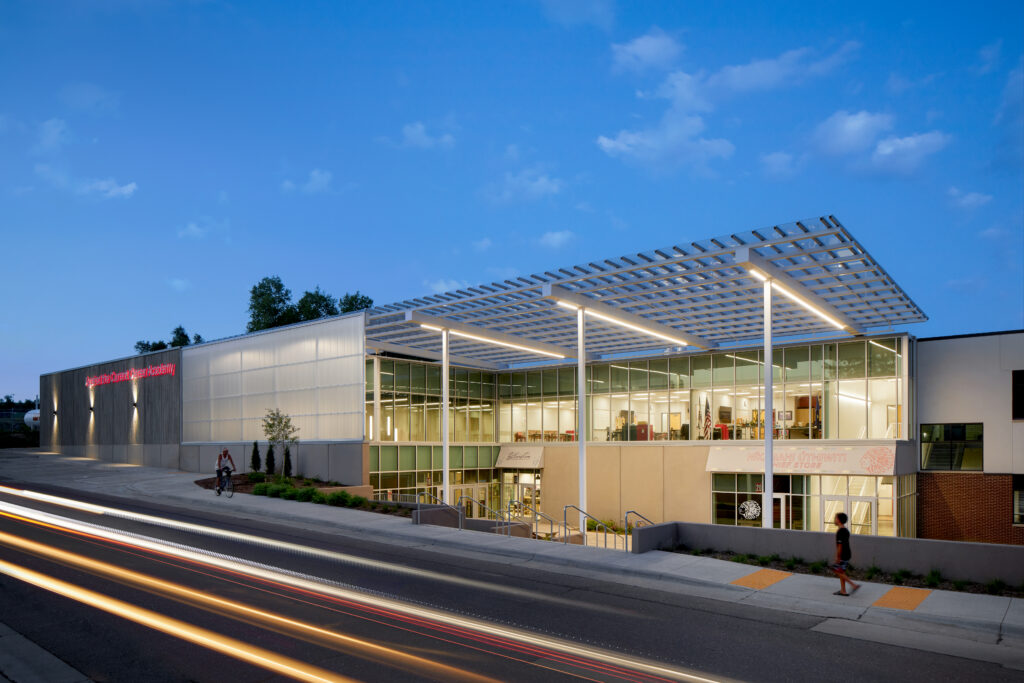
In Macy, Nebraska — a village of 795 residents in northeastern Nebraska — a building announces itself with intention. Positioned prominently on Main Street, the Career Academy addition to Umóⁿhoⁿ Nation Public School is more than an expansion of a K–12 campus. It is a declaration of possibility.
Completed in 2022, the 38,000-square-foot, two-story addition has already earned national recognition, including a Best of the Best K–12 Education award from Engineering News-Record. But for the Umóⁿhoⁿ (Omaha) Tribe of Nebraska, the project’s significance is measured less in accolades and more in impact. In one of the most economically challenged communities in the state, the Academy represents a deliberate strategy to redefine what success looks like for students — and to root that success firmly within the community.
Redefining Success
The word ‘Umóⁿhoⁿ’ [Omaha] translates to “Against the Current,” a phrase that became both inspiration and mission. When school administrators began envisioning a career-focused addition, they engaged tribal elders and community leaders in conversations about local needs. A recurring concern surfaced: too many graduates were leaving school without marketable skills, while the reservation faced critical shortages in healthcare, childcare, construction trades, automotive repair, retail access, and food service.
The Academy was designed as a direct response to these concerns. Stacie Hardy, school superintendent, notes that the Against the Current Career Academy (ACCA) was established from “a vision to provide meaningful, hands-on career and technical training for students while addressing critical workforce needs within an economically underserved tribal community. Recognizing that many rural and reservation communities experience significant shortages of skilled labor, the academy was designed to create clear career pathways in high-demand fields. By integrating rigorous academic instruction with real-world, experiential learning opportunities, ACCA equips students with practical skills, industry certifications, and valuable work experience while they are still in school. This approach not only enhances student engagement and career readiness but also supports long-term community development. Ultimately, the academy seeks to strengthen both individual opportunity and the local economy by preparing the next generation of skilled professionals who can contribute to the growth, resilience, and self-sufficiency of the community.”
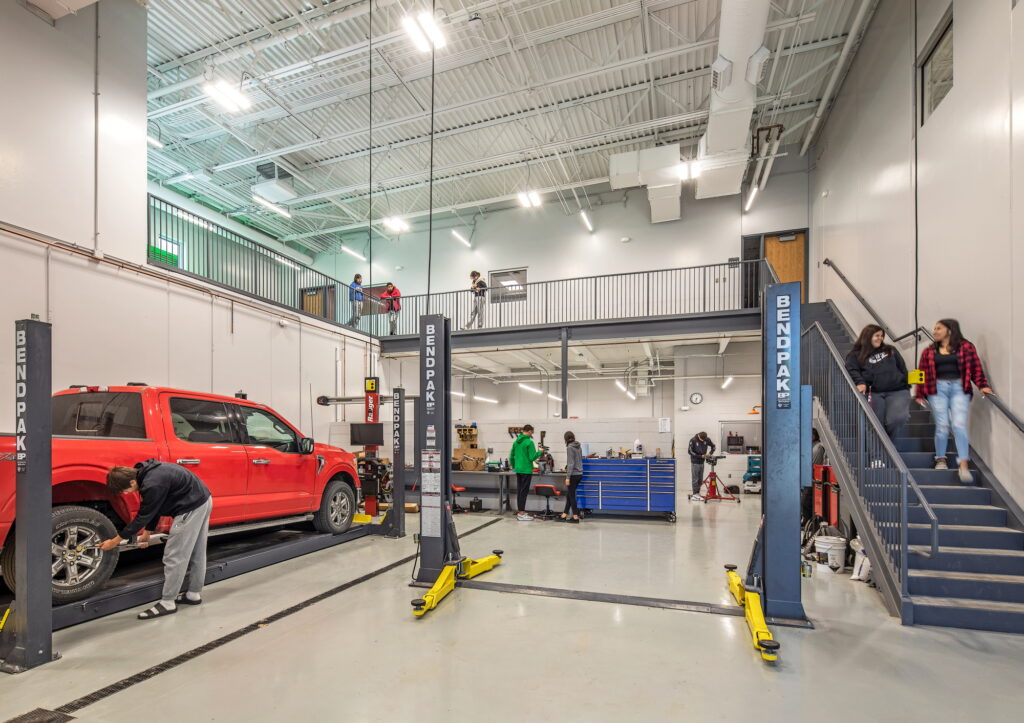
Rather than framing postsecondary success solely through a four-year college lens, the district developed six distinct career pathways:
- Business/Entrepreneurship
- Early Childhood Education
- Construction
- Automotive Technology
- Nursing/Health Sciences
- Culinary Arts
Students enter pathways as juniors, gaining two years of immersive, hands-on learning in environments that mirror real-world workplaces. Many graduate with industry-recognized certifications, including Certified Nurse Assistant (CNA), Medication Aide (Med-Tech), Snap-On (Automotive), ServSafe Food Handler and Food Protection Manager (culinary).
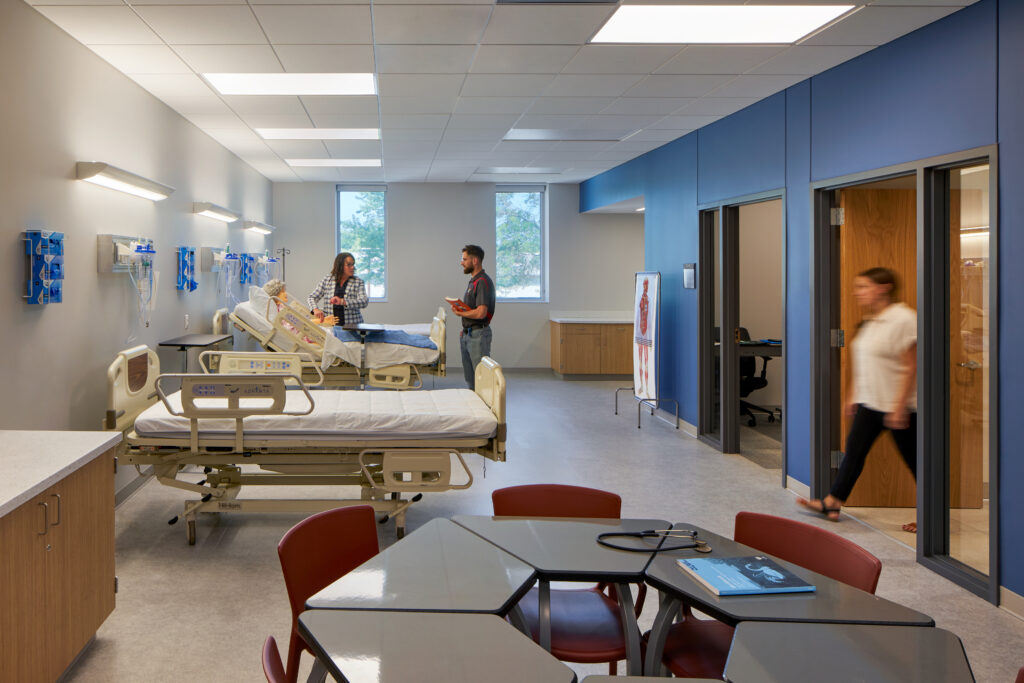
Additionally students participate in HOSA (Future Health Professionals) and Skills USA (CTE Student Organization) to further their knowledge of career opportunities. All this, paired with earning dual enrollment credits, ensures students can pursue higher education if they choose, while also equipping them to secure meaningful employment with sustainable income — or launch their own businesses — immediately after high school graduation.
A School That Functions as Infrastructure
The Career Academy does not operate as a closed academic wing. It functions as civic infrastructure with constant community interaction.
The culinary pathway runs Bluestem Coffee House and Café, the community’s only café and gathering space. The entrepreneurship pathway manages the Chief Store, the town’s first retail store in years which allows students and community members to sell their locally produced goods to help support themselves. Early Childhood Education students gain experience in an on-site childcare center that supports teen parents and working families. Construction and automotive students perform real repairs and service projects within the community, addressing needs that previously required travel of 40 miles or more.
More recently, an agricultural initiative began cultivating native crops — Indian corn, beans, and squash — along with produce for salsa and other food products. The harvest supplies the school lunch program, the student-run store, and local families, reinforcing food sovereignty and cultural continuity.
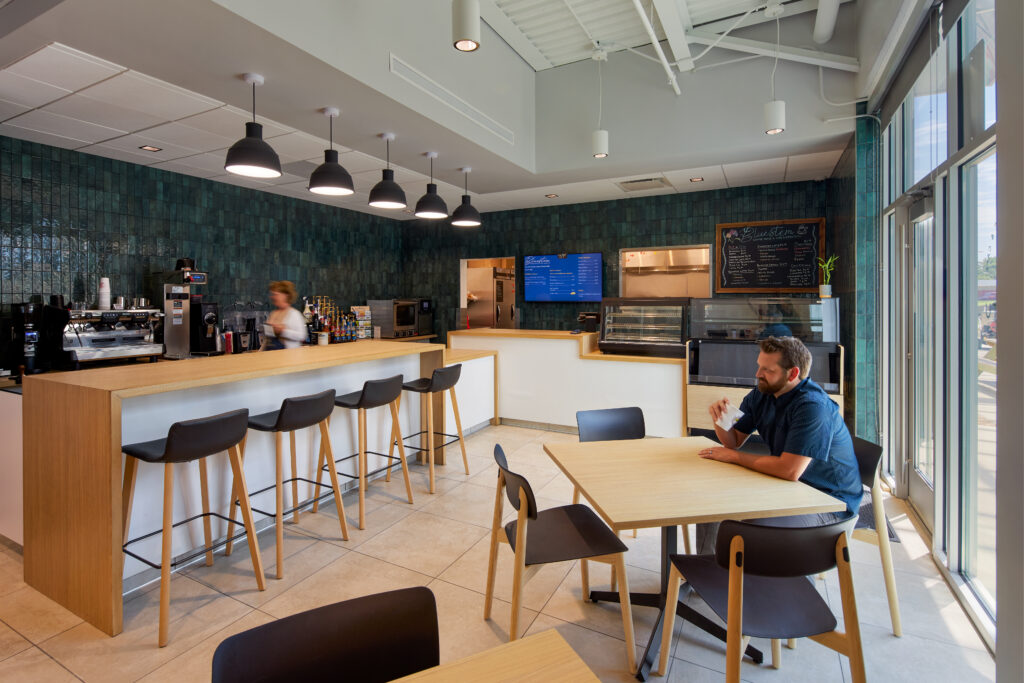
Each pathway occupies dedicated instructional classrooms paired with specialized labs or production spaces. Yet the design intentionally integrates transparency and adjacency, allowing students to see one another’s work and fostering a sense of shared enterprise. The building’s café frontage and retail awnings reinforce a “Main Street” character, signaling openness and public engagement along the primary thoroughfare through town.
“Visibility is important for both the community to engage with the school, and for the students to see opportunities that they may not have ever considered,” Commented Cleve Reeves, Principal at BVH Architecture. “This building represents so much more than a typical school. The vitality of this community is growing within each student and community member interacting with this new facility. It truly has a revitalizing effect for the Tribal community at large, providing services that otherwise are an hour away and creating future career paths for students.”
Designing for Identity
Cultural identity guided the architectural language. Tribal colors and symbolic references to cardinal directions are woven into interior finishes and wayfinding. Native plantings anchor the landscape design, connecting the structure to its geographic and cultural context.
Inside, the 300-seat auditorium serves both school and community events, expanding access to fine arts and providing a venue for gatherings that previously lacked an appropriate home. Participation in arts programming has increased, and administrators note a broader shift in student pride. Incidents of vandalism and graffiti have declined—a tangible reflection of ownership and respect.
The addition connects to the existing K–12 building on both first and second floors along the north façade, ensuring operational efficiency while clearly establishing its own identity. New administration offices, a board room, flex classrooms, restrooms, and an elevator support both daily function and long-term adaptability.

Building for Isolation and Resilience
Constructing on a rural reservation demanded heightened scrutiny of systems and materials. Availability of replacement parts, durability under heavy use, and long-term maintenance costs were evaluated beyond typical benchmarks. Mechanical, electrical, fire protection, telecommunications, and security systems were selected with resilience and serviceability in mind, acknowledging the challenges of geographic isolation.
When you spend time with the students, staff and community members in Macy, you are quickly reminded that the Academy is not simply a facility, but a framework for generational change.
The project scope encompassed civil and landscape improvements alongside architectural, structural, and building systems design. Compared to traditional school construction, the design team approached each specification through a lens of longevity and stewardship — recognizing that repairs or replacements can carry amplified cost and logistical hurdles in remote settings.
Yet durability did not come at the expense of inspiration. Daylit spaces, material palettes that reflected the tribe’s culture, and transparent learning environments elevate the student experience. The building resists wear while conveying dignity — a balance critical to its mission.
A Replicable Model
When you spend time with the students, staff and community members in Macy, you are quickly reminded that the Academy is not simply a facility, but a framework for generational change.
Its model — aligning career pathways with local economic gaps, embedding public-facing enterprises within school walls, and grounding design in cultural identity — offers lessons for rural and Indigenous districts nationwide. It demonstrates how educational environments can move beyond preparation for departure and instead prepare students to lead where they are.
At the Against the Current Career Academy (ACCA), tomorrow does not begin after graduation. It begins each morning when students unlock the café doors, stock store shelves, care for young children, or harvest produce from tribal lands. The building stands at the heart of town not as an endpoint, but as a current — steady, intentional, and powerful — moving the community forward.