


Over the past decade, the K-12 education building environment has made significant progress in rethinking what schools can be. Flexible classrooms, collaborative learning environments, and student-centered spaces are no longer experimental, they are increasingly expected. Architects, furniture manufacturers, and educators have collectively pushed school design beyond rows of desks and double-loaded corridors toward environments that better reflect how students learn today.
But as innovation accelerates, an important question remains: Are these environments truly changing daily teaching and learning, or are we calling these “successful” too early?
Too often, new schools are evaluated at the moment of completion when the building opens, furniture is installed, and students move in. The photos look great. The story feels complete. But the real measure of success shows up later when educators begin adapting spaces to their own teaching styles, constraints, and school culture.
That gap between design intent and daily reality is where the most valuable lessons live. And it’s where the education environment still has the most to learn.
From Vision to Everyday Use
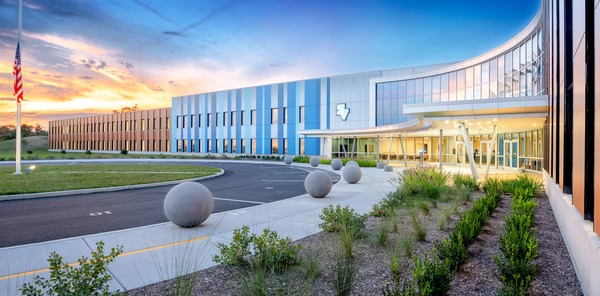
In 2018, our team partnered with the Seneca Valley School District to replace an aging K–6 school building. The goal wasn’t just to deliver a new facility, it was to challenge long-held assumptions about what a learning environment should do or how they should be. Rather than replicating a familiar model, the district and design team aimed to create a school that supported exploration, collaboration, and choice, an environment flexible enough to respond to evolving teaching practices over time.
One of the most influential perspectives came from an unlikely source, which was the Children’s Museum of Pittsburgh. Museums, unlike schools, are places where learning is optional, and yet deeply engaging. That distinction shifted the conversation. If children are naturally drawn to environments that invite curiosity and self-directed exploration, what can those spaces teach us about formal education? The museum’s approach reinforced something that often gets overlooked in school design “agency” which is embedded in the environment itself. It’s shaped by scale, visibility, access to materials, freedom of movement and freedom of choice.
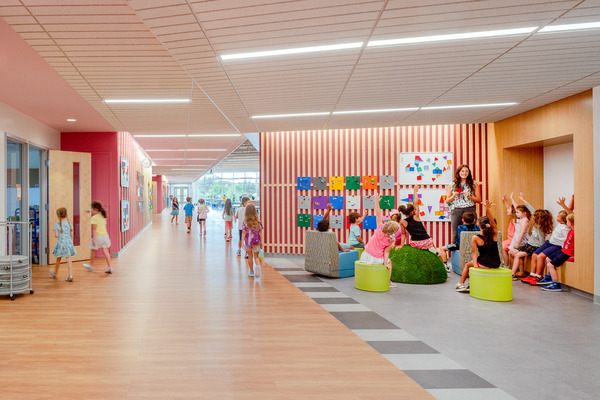
Those ideas translated into adaptable learning spaces, shared zones that blurred the boundaries between classroom, collaboration, and corridor, and environments designed to support multiple teaching styles rather than a single prescribed model. And once the building was occupied, we saw something important: the space didn’t just “house” learning, it began nudging behavior. Not in a dramatic, overnight transformation, but in small, consistent ways. Students used the building differently depending on the task. Educators began testing what worked for them. The environment became part of the instruction.
Within the open collaboration areas, we introduced three distinct types of teaching walls, analog, digital, and curated each designed to support a different mode of engagement from the student. The analog walls allowed for quick thinking, sketching, and group ideation. Digital walls supported interactive lessons, media-rich content, and whole-group collaboration. Curated walls, put student work on display, reinforcing progress and making learning visible.
Together, these varied surfaces gave students meaningful choices in how they engaged with content. Over time, we observed students gravitating toward the wall that best matched their task or learning style, which subtly shifted ownership from the teacher to the learner. The walls were no longer just presentation tool they became active participants in the learning environment.

Lesson 1: Flexibility Must Be Intuitive
Flexibility has become one of the most-used words in future-ready school design. Sometimes it’s earned. Sometimes it’s a buzzword.
At Ehrman Crest Elementary and Middle School, we intentionally designed the flexible areas to subtly invite change rather than demand it. We relied less on signage, scheduling, or “special use” instructions and more on the environment itself. Movable furniture that could be shifted quickly, varied pieces that clearly signaled a different mode of learning, and layouts that could adapt without a reset or a complicated routine.
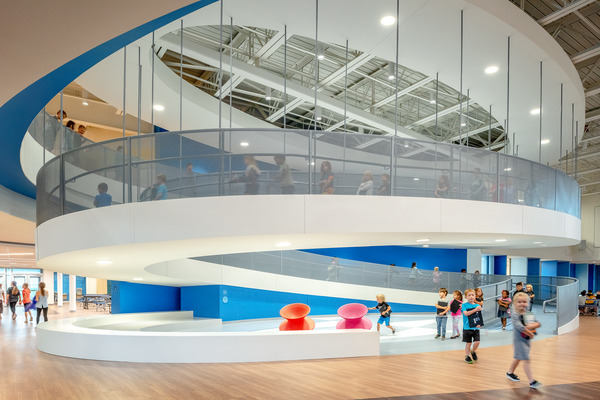
Just as important, we made these zones part of the everyday circulation pathway. Students and teachers had to touch the space every day walking through it, passing it between classrooms, and using it naturally as they moved. That was intentional. It kept the area from feeling like a separate destination that required permission or a special plan. Instead, it became an extension of the classroom available in the moment, when a lesson needed to expand, a group needed to break out, or students needed a different setting to stay engaged.
In contrast, environments that subtly invite change through the scale of furniture, easy access to power, clear adjacencies, and “grab-and-go” usability they are more readily embraced. Educators won’t experiment if it feels like moving parts could create friction, chaos, or lost time.
For the schools, the implication is simple: flexibility should not be defined by the number of configurations a space “could” support, but by how often those configurations are realistically used on a normal Tuesday, not during a showcase tour.
Lesson 2: One School, Many Users
A single building will always serve educators with different backgrounds, experiences, and comfort levels with change. New teachers, veteran educators transitioning from older facilities, and staff arriving from other schools can interpret the same environment in very different ways.
Some embrace open, shared spaces as opportunities for collaboration and innovation. Others gravitate toward more familiar layouts that offer predictability and control. Neither response is “wrong.” But together, they highlight an important truth: Schools must support a spectrum of teaching styles, not just an idealized future state.
Designing for choice, providing a range of spatial conditions within the same building proved far more effective than assuming a one-size-fits-all solution. That conclusion wasn’t theoretical; it came directly from teacher feedback during early occupancy, as educators described how different settings supported different instructional moments from small-group work to quiet reset to active collaboration. This lesson extends beyond architecture to furniture systems, technology integration, and operational planning.
Each classroom included an adjacent small‑group room, creating a range of learning environments within immediate reach. While outfitted with the same technology as the classroom, these rooms were designed with varying amenities, such as color‑changing lighting and soft seating to support different student needs. For some learners in my observations, the space served as a quiet, calming environment where they could reset and re-engage without being removed from instruction. This approach allowed students to access support while maintaining connection to their classroom community.
Lesson 3: Collaboration Needs Structure
Collaboration is frequently equated with openness, but openness alone doesn’t produce collaborative behavior. In practice, successful shared environments strike a balance between visibility, acoustics, and a sense of ownership.
When collaboration zones lack clear definition, they risk becoming underutilized or worse, becoming a source of distraction. But when these spaces are thoughtfully scaled and supported with appropriate furnishings, acoustical strategies, and visual cues, they become powerful extensions of the learning environment.
And to be candid, not every shared zone works perfectly on day one. Some spaces take time to find their role. In early occupancy, certain areas may be used less than expected or differently than planned. That isn’t failure, it’s feedback. It’s the building teaching you how it’s actually being used.
Designing for change means acknowledging that no school is ever truly finished.
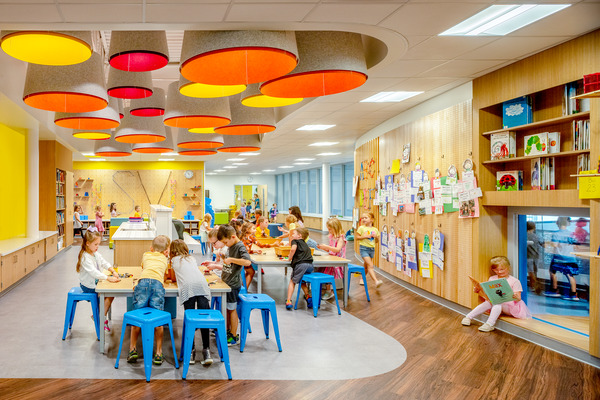
For this project, we intentionally selected furniture for these spaces that was distinctly different from what students encountered in the classroom. The goal was not variety for its own sake, but to signal that these areas supported different types of learning and behavior.
By offering alternative seating options and varied furniture typologies, students were given agency to choose an environment that best supported their task or mindset. These spaces invited different interactions, different levels of comfort, and ultimately different outcomes reinforcing the idea that learning does not happen in only one posture or setting.
For furniture manufacturers, this underscores the importance of systems thinking. Individual products matter, but how those products work together and how easily educators can adapt them which matters more.
Redefining Success in School Design
These lessons lead to a larger shift in the education environment, we shouldn’t measure success solely at occupancy or the award we receive. Instead, schools should be viewed as evolving systems, environments that change as teaching practices, staffing, and student needs evolve. Designing for change means acknowledging that no school is ever truly finished.
Implications for the K-12 Education Environment
For Architects and Designers — Designers are increasingly asked to create environments that support change, innovation, and personalization. To do so effectively, teams must:
- Measure success beyond the ribbon cutting
- Design for transition, not just the end state
- Engage educators early and often and revisit assumptions after occupancy
For Furniture Manufacturers — Products play a critical role in how spaces function day to day. Key considerations include:
- Ease of reconfiguration and durability
- Integration with other systems and furnishings
- Support and training that empower users, not overwhelm them
For Educators and District Leaders — Innovative spaces are powerful tools, but they are not silver bullets. Districts benefit most when:
- Change management is planned alongside design
- Educators are given time and support to adapt
- Feedback is actively gathered and applied throughout the whole process
Looking Ahead: Designing Schools That Learn
As the education environment continues to evolve, the next phase of school design will be defined less by bold concepts and more by evidence, reflection, and adaptability. In practice, the schools that succeed over time tend to be the ones where teams stay involved, listening, adjusting, and resisting the urge to declare victory too early. Because opening day isn’t the finish line. It’s the starting point.
By shifting focus from completion to continuous growth, the industry has an opportunity to create environments that not only look innovative on opening day but continue to support meaningful learning for years to come.