


The first article in this series explored why multi-user restrooms — long accepted as a default — never truly met the needs of students or the realities of school safety. They were built for efficiency, not humanity. They solved for cost, not care. And for more than a century, we’ve tried to evolve a design that was never capable of delivering safety, privacy, or dignity in the first place.
If we want different outcomes, we have to examine different models. Fortunately, privacy-centered restroom designs already exist all around us — in convenience stores, restaurants, offices, and airports. What schools have lacked is not access to better ideas, but permission to rethink restroom design itself. This article explores what those models teach us — and how a school-specific approach can better support the developmental, functional, and emotional needs of students.
Before defining what schools need, it helps to look at the models people already experience — and often prefer.
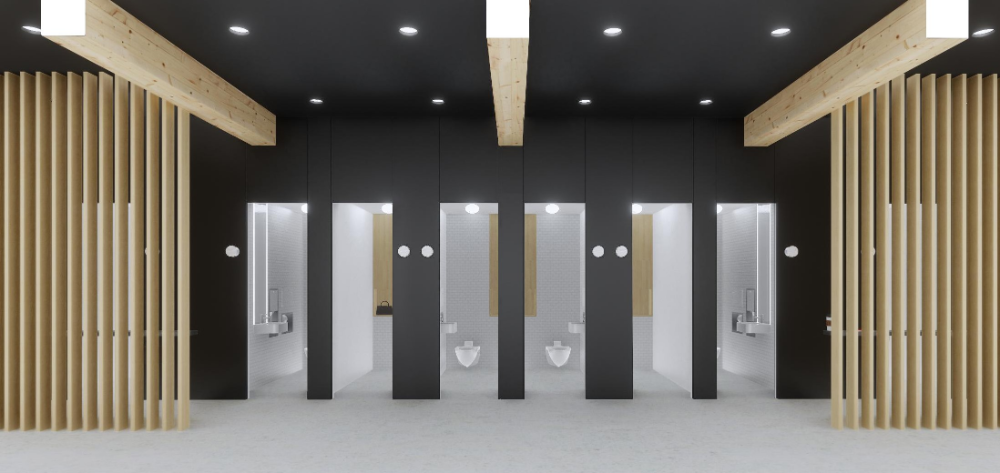
For many Texans, a familiar example is the Buc-ee’s model, where each user enters a fully enclosed toilet room with a solid door, durable materials, and enough acoustic separation to feel genuinely alone. These spaces provide strong individual privacy, but remain embedded within gender-segregated zones. While the experience inside the room is effective, the broader system still relies on assumptions about gender and does not fully address supervision of non-private functions, which remain in areas where privacy is expected.
Many restaurants offer another version: the single-user, all-in-one restroom. These spaces combine toilet, sink, mirror, and disposal fixtures behind a single locked door. They offer the highest level of privacy, but do not scale in environments where large groups move quickly. In schools, where hundreds of students may use restrooms within minutes, this model creates bottlenecks and limits visibility in ways that complicate supervision. At scale, it can also become cost-prohibitive.
Some restaurants use a hybrid approach that more closely aligns with what schools need. In these environments, toilet stalls provide high levels of physical and acoustic privacy, while sinks and mirrors are located in a shared, non-private space. This arrangement allows routine functions to occur in visible areas, while preserving privacy where it matters most.
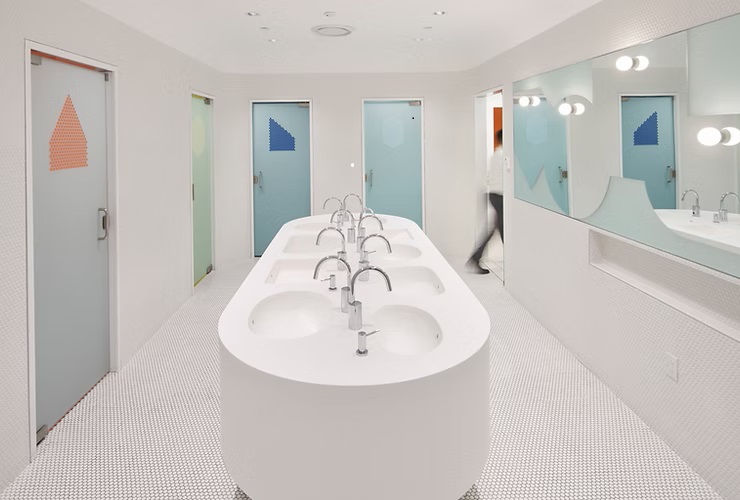
Together, these models reveal an important principle: privacy is not about placing everything behind a door — it is about placing the right functions there. When applied intentionally, privacy protects dignity without creating the blind spots that allow harm to occur. It also removes gender as a qualifier for accessing a restroom.
Schools are fundamentally different from these examples. Student restrooms exclusively serve young people who are still developing socially and emotionally — many of whom need privacy for dignity and safety, while also benefiting from environments that provide structure and accountability. Schools must move large groups efficiently, maintain facilities under constant use, and support a wide range of needs.
The common restaurant model is too slow. The Buc-ee’s model is too segregated. The multi-user model is too unsafe. Even the hybrid restaurant model presumes a level of maturity that cannot be assumed in school settings.
What schools require is a unique single-user approach — one that borrows the strengths of these models while addressing the realities of childhood and adolescence. That means separating private and non-private functions in a way that preserves dignity while restoring appropriate visibility. In this approach, students use the toilet in a fully enclosed, single-user space, then step into a shared, non-private area for handwashing and grooming. This separation allows adults to supervise without intrusion, reduces opportunities for harmful behavior, and supports efficient movement during high-traffic periods. It also removes unnecessary barriers created by gender segregation, allowing students to move through the space based on availability rather than assignment. The result is not more control — it is better alignment between design and human behavior.
A Five Phases mindset expands how we think about restroom design. Instead of focusing only on function and cost, it asks how the built environment can prevent harm — not just mitigate it.
Much of the built environment has been shaped by preparing for events that cannot be avoided. That history has served architects well, but not all risks are inevitable. In school restrooms, many of the most common forms of harm — harassment, bullying, vandalism, and misuse — are behavioral and preventable. That distinction matters.
Design influences behavior in two key ways: it can make harmful actions more difficult to carry out, and it can create environments that support regulation, safety, and belonging — conditions that reduce the likelihood that people want to cause harm in the first place. All design sits at the intersection of prevention and mitigation. Restroom design offers a clear opportunity to engage both more intentionally. When privacy is applied precisely — rather than broadly — it becomes protective instead of permissive, reducing opportunities for harm while preserving dignity.
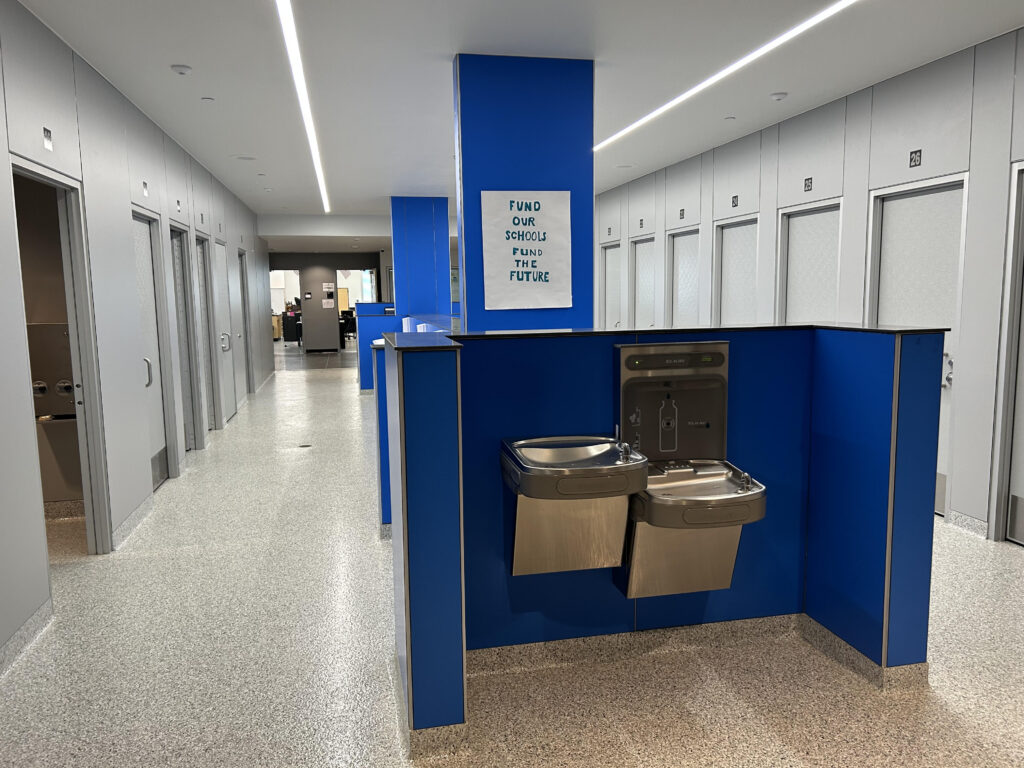
When these principles are applied in a school setting, the result is not a single feature, but a system—one that separates privacy and visibility so both can function as intended.
This approach begins with fully enclosed, single-user toilet rooms designed to provide true visual and acoustic privacy. Unlike traditional stalls, these spaces are detailed so privacy protects the user without creating conditions where harm can be concealed.
Walls extend high enough to prevent visual breaches — such as a phone held over the wall — while remaining slightly below the ceiling to maintain continuous HVAC, fire suppression, lighting, and emergency systems. Doors are solid and framed, reinforcing durability and a clear sense of enclosure. Occupancy indicators on both sides reduce uncertainty for users and confirm that locks are properly engaged.
A critical feature is a louver located in the lower portion of the door, with blades angled downward toward the floor inside the room. The spacing prevents a phone or camera from passing through while still allowing adults to confirm that the room is occupied by a single individual. This detail supports supervision without compromising dignity.
These rooms are intended for one user at a time. Any condition suggesting multiple occupants signals a need for immediate attention, reinforcing that the space is both private and accountable. Accountability is further supported through camera placement in adjacent circulation areas. While no recording occurs inside the room, entries and exits are visible, allowing administrators to review activity if needed.
At the same time, this model recognizes that certain behaviors — such as vaping — can still occur within a single-user space. Because these actions can be concealed and do not require multiple occupants, schools should continue to incorporate vaping detection systems within toilet rooms or nearby. This is not a limitation of the model, but an example of a Five Phases mindset — where prevention and mitigation work together to make misuse more difficult through accountability, whether the misuse is visible or concealed.
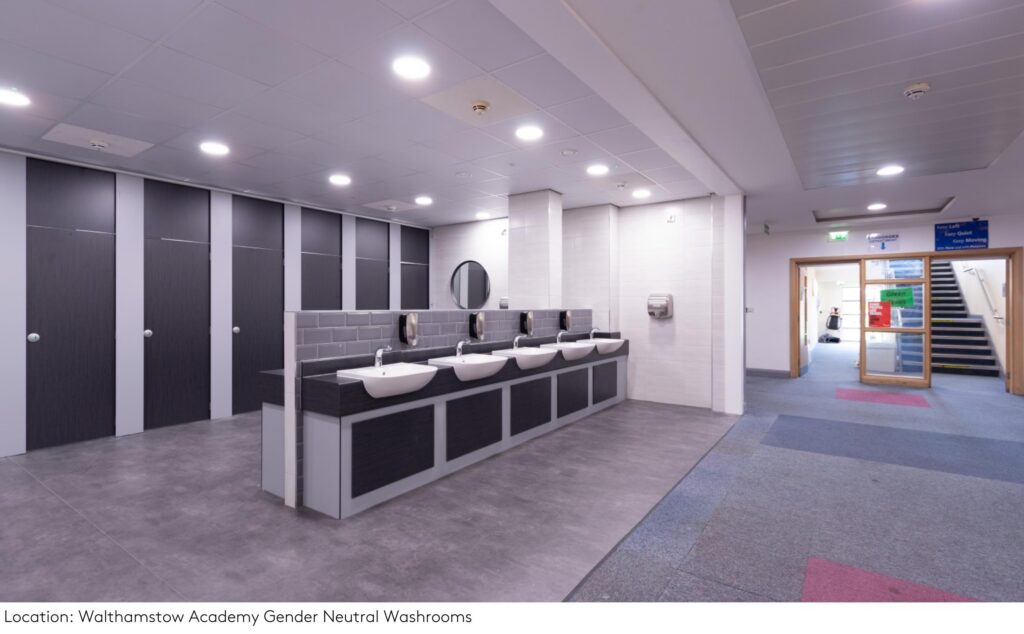
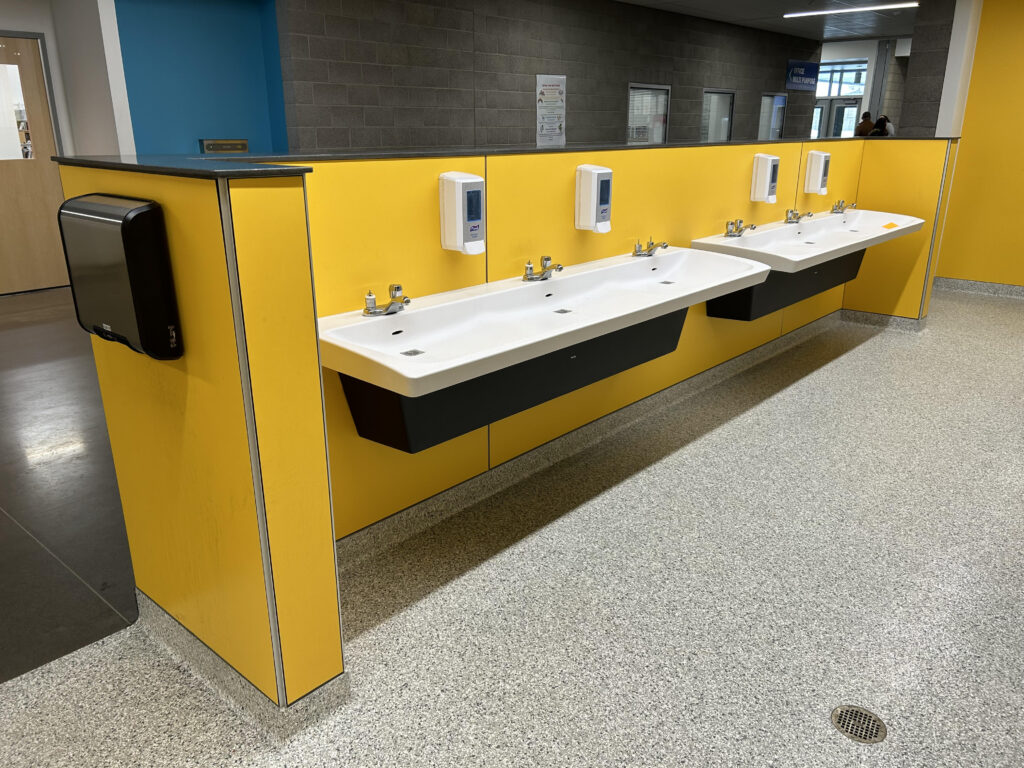
Adjacent to the private rooms is a shared, non-private zone for handwashing and grooming, designed for visibility and flow.
Located directly alongside circulation, this space makes it clear that adult presence is appropriate without compromising privacy. Partial-height walls define the area without enclosing it, preserving visibility while signaling separation. Circulation is intentional, with a path into the space and a separate path out, reducing congestion during peak periods. Students can move through efficiently without being forced into a queue if they only need access to the non-private zone.
What matters most is keeping privacy, visibility, and prevention at the center — so design decisions consistently set all students up for success.
Visibility also shapes behavior. Activities common in enclosed restrooms — such as splashing water, misusing paper products, or gathering without purpose — become less appealing when observable. For younger students, this reinforces appropriate habits without constant correction. Materials are durable, easy to maintain, and selected to remain safe under wet conditions, ensuring the space performs reliably under daily use.
Together, these zones create a system where privacy and supervision are no longer in tension, but purposefully aligned—supporting both dignity and safety. This is not an exhaustive solution, but a framework for thinking differently about school restroom design. It can be adapted, expanded, and refined to meet the needs of different students and contexts. What matters most is keeping privacy, visibility, and prevention at the center — so design decisions consistently set all students up for success.
When privacy is designed with intention, the student experience shifts. Restrooms become predictable, functional, and safe. Students are less likely to avoid them, and opportunities for bullying, sexual assault, and other forms of misconduct decrease — not because of stricter rules, but because the environment no longer conceals those behaviors. This also reduces the burden on educators. With fewer incidents to address, teachers and administrators can focus more fully on instruction and student support, strengthening the overall school climate.
This is not about a single design feature. It is about recognizing that school facilities are investments in people. The environments we create shape how students feel, how they behave, and how they engage in their learning. A privacy-first restroom model aligns the built environment with those outcomes. It reflects a commitment to safety, dignity, and belonging — not as abstract ideals, but as daily lived experiences. Children deserve these conditions just as much as adults do — if not more, as they are still developing their understanding of the world around them.
The final article in this series turns from design principles to lived experience. Districts that have adopted this model — and the students who use these restrooms every day — offer a clearer picture of what actually changes when privacy is applied with intention. Their experiences show that the shift is not simply architectural; it reshapes school culture, reduces harm and the need for discipline, and strengthens student confidence. That article will also outline a call to action for architects, school leaders, and policymakers — because rethinking restroom design is not just about new ideas, but about the willingness to implement them in ways that truly serve every student.