


Since the development of modern office desk work in the early 19th century and the simultaneous decline of physical labor in the workplace, human physiology and health has measurably evolved. In recent decades, an increasing body of scientific research has concluded that declining human activity in industrialized economies has led to chronic pain, obesity, arthritis and other ailments. Likewise, growing data sets are also suggesting how these physiological shifts and behaviors are affecting our brains, in terms of energy levels, mood, concentration and engagement. The overall picture is that our physical behaviors at work, and at schools and universities, is influencing our physical health and our cognitive performance.
In the classroom, this means that that our brains are less able to absorb the subject matter that is presented and taught. While caffeinated beverages are widely used to help address problems of fatigue and cognitive engagement, the design of learning environments could be improved to address these challenges. Even though learning environments have evolved to increase physical activity and flexibility in the classroom through active stools and sit stand desks, still more could be done. Recent science, for example, reveals that stretching along with other forms of light metabolic activity can increase cognitive functioning and performance.1,2
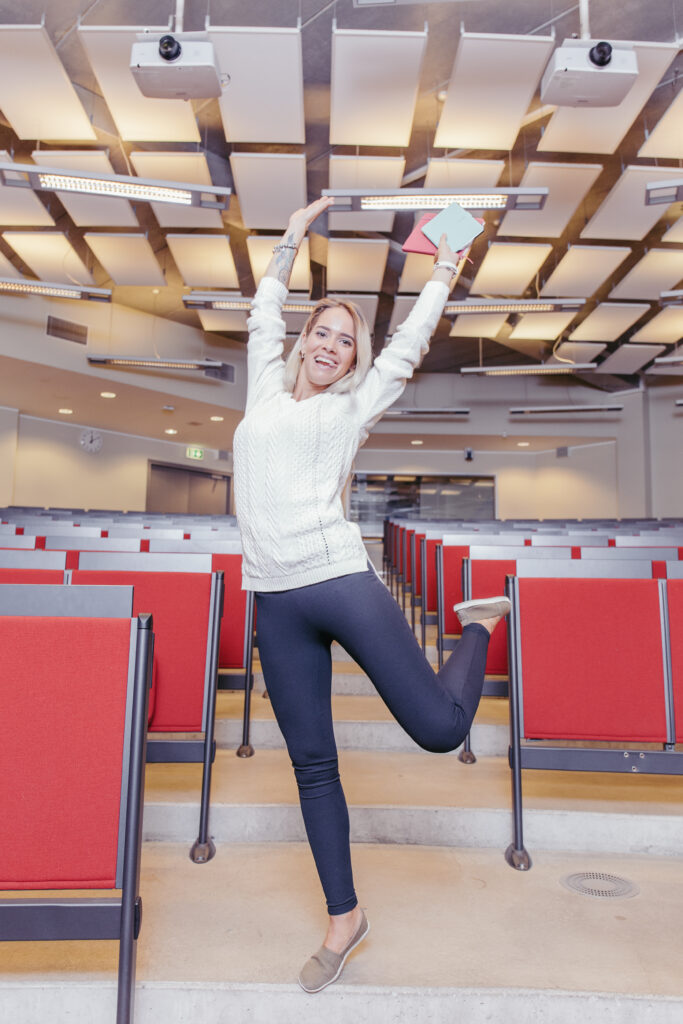
According to the Metabolic Equivalency of Task framework (MET), stretching would fall into ‘low to moderate’ activity, between tasks such as standing and doing dishes and brisk walking. Vigorous activity, in contrast, includes jogging and playing team sports like soccer or basketball, which is not the level of activity needed to produce cognitive results. Nevertheless, classroom spaces remain mostly designed to keep students sitting still and promote little if any activity at all.3
Through a project collaboration between Steelcase’s WorkSpace Futures Group and Virginia Tech, an interdisciplinary team of researchers set out to explore how furniture in educational environments could encourage stretching to support cognitive performance for the benefit of better learning. Chief amongst the goals of this project was to uncover ways to make what seems like an out-of- place activity more socially and pedagogically acceptable.
Throughout the design research program, experts in Human-Centered Design Innovation, Health Sciences and Ergonomics collaborated to explore how this goal might be achieved. Using an iterative, participatory design process, the project involved enrolled students and faculty in developing, testing and critiquing learning space furniture concepts. In the end, the team uncovered new ways in which stretching and increased light physical activity could be encouraged and broadly enabled throughout university learning environments.
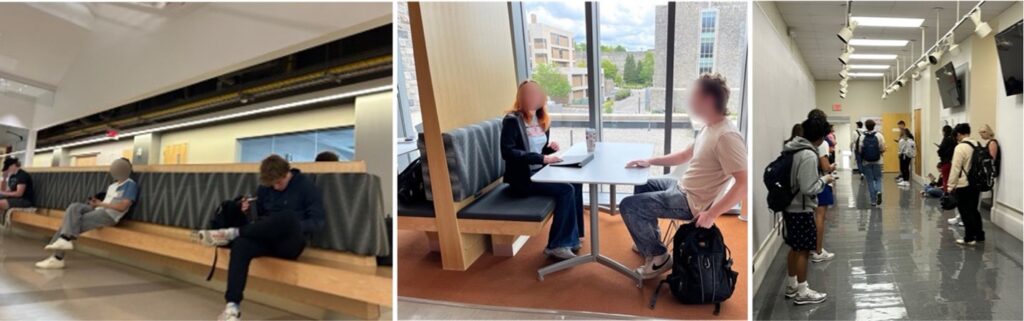
Early on the team discovered how, where and for how long university students spent time during the day in between class. Often students ended up waiting in what we defined as ‘Interstitial Spaces’ where they would relax, do homework, check their messages and sometimes sleep before their next class or activity (Figure 1). These interstitial spaces, not unlike airport concourses where travelers wait for their upcoming flights, offer an open opportunity to encourage increased physical activity including stretching. At present, we found that most furniture in these spaces is focused on relaxion, with comfortable seating and desks for doing homework (for messaging, listening to music or playing games). Much of the furniture referenced living room typologies, lending themselves more to leisure than activity.
After conducting an initial survey with current students and faculty in which we asked about their perceptions of light physical activity on campus, we learned that most respondents were interested in finding more opportunities to do so, for health, fitness and mental ‘vitality.’ Most had already attempted to be more active in other ways; many used digital activity trackers on their phones or through wearables (Fitbit, Whoop, Apple Watch etc.). Despite the theoretical desirability of increasing physical activity during the day, there were also some practical concerns. These included social taboos such as getting sweaty and looking silly in front of peers and simply feeling tired.
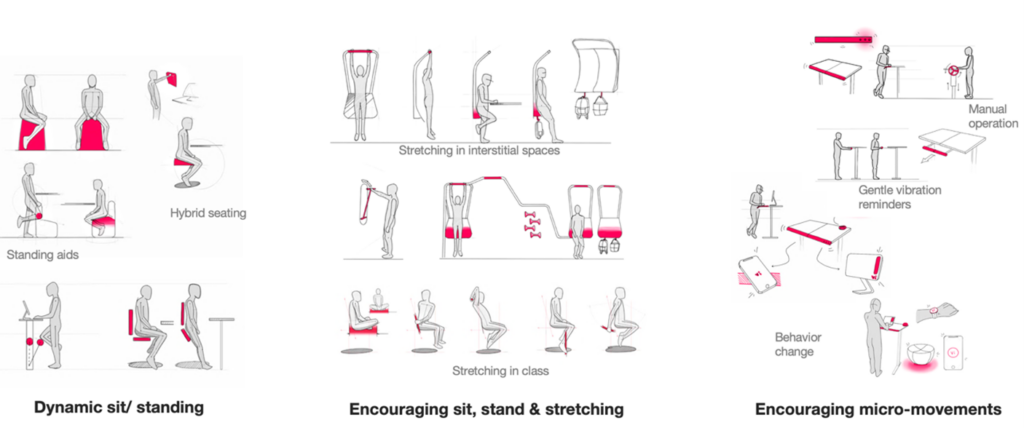
Informed by these initial learnings, we held ideation sessions with students and faculty resulting in a collection of design concepts (Figure 2). Later we narrowed the number concepts which we then prototyped into rudimentary sittable pieces for evaluation. We recruited students and faculty to attend feedback focus group sessions to try these prototypes and assess and discuss their value (Figure 3).
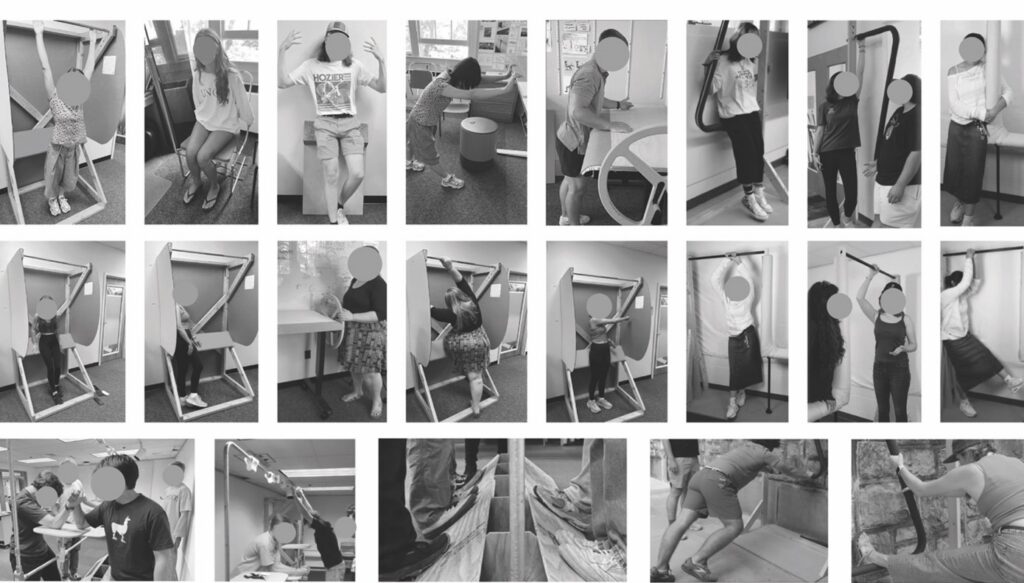
The outcome of these focus group sessions offered the following main insights:
- Students and faculty are looking for ways to increase activity during the day
- Providing some discretion while stretching can encourage active behavior
- Facilitating social interaction while stretching can also encourage active behavior
- Faculty are willing to integrate activity into class time breaks.
Diving further into greater detail, we also uncovered valuable nuances about how such speculative furnishings might be designed to meet student perceptions and encourage their use. Using word and image sorting research techniques we also found that students sought elements to support and a sense of energizing calm, not unlike the colorful comforting qualities of ‘athleisure’ apparel brands like Lululemon. Such design cues would help communicate the nature and value of the vitality furniture pieces to those encountering them for the first time.
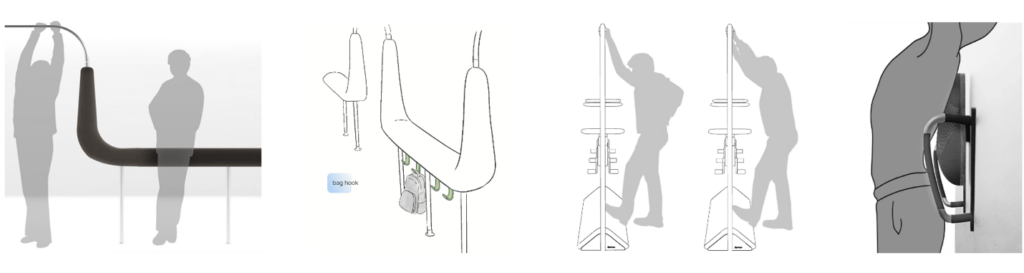
By the end of the project, we concluded that there was an unmet market opportunity to integrate activity into learning environments by designing a collection of ‘vitality’ furnishings that would offer and encourage a variety of stretching options. These could be deployed in interstitial spaces, but they could also be integrated into traditional classroom as seating or otherwise (Figure 4). We also concluded that perceptions and attitudes toward light activity behaviors, including stretching must evolve and be supported.
To ensure success, such interventions need the institutional support of faculty and University administrators. New behaviors that challenge social norms would have an adoption learning curve just as early standing desks and active stools did. With further development and user testing with students and faculty in learning environments, there is great potential to support student learning outcomes through increased and pervasive opportunities to engage in light activity including stretching.
At present the project is being considered for pilot development.
Additional contributors include:
- Dr. Stella Volpe, Professor Health and Human Nutrition, Virginia Tech
- Dr. Yoon Choi, Assistant Professor ID, Virginia Tech
- Dr. Sarah Parker, Health Systems and Implementation Science, Virginia Tech
- Kelly Cramton, Director, Marketing, Steelcase Learning
- John Allen, Director of Design, Steelcase
- Paul Noll, Principal Researcher, Steelcase
- Kevin Butler, Certified Professional Ergonomist, Steelcase
- Marisa Sergnese, Applied Research and Learning Consultant, Steelcase
- Jason Cusack, Instructor, ID, Virginia Tech
Student Research Assistants:
- Jessica Bryan, Health and Human Nutrition, VT
- Karissa Konezny, ID, VT
- Emersen Sweeney, ID, VT
- Sara Truffant, ID, VT
- Claudia Kellam, ID, VT
- Charlie Higgins, ID, VT
- Matteo Chiappetta, ID, VT
- James Tury, ID, VT
- Eira Calderon, ID, VT
- Jonathan Biancaniello, ID, VT
References:
1 Sudo, M., Ando, S., & Nagamatsu, T. (2015). Effects of acute stretching on visual search performance and mood state. Journal of Physical Education and Sport, 15(4), 651-656. https://doi.org/10.7752/jpes.2015.04099
2 Tamura, A., Murayama, K., Ishii, R., Sakaki, M., & Tanaka, A. (2022). The effect of low-intensity exercise on emotional and cognitive engagement in the classroom. Science of Learning, 7(9). https://doi.org/10.1038/s41539-022-00125-y
3 Jetté M, Sidney K, Blümchen G. (1990) Metabolic equivalents (METS) in exercise testing, exercise prescription, and evaluation of functional capacity. Clinical Cardiology, 13(8), 555-65. https://doi.org/10.1002/clc.4960130809. PMID: 2204507