


I still remember standing in a brand-new school building that everyone was proud of. The walls were fresh. The furniture had just been unwrapped. The technology was installed, tested, and working. From the outside, it looked like progress. As educators began moving in, I heard the same conversations I’d heard for years:
- “We want students collaborating more.”
- “We want more ownership.”
- “We want learning to feel real.”
No one had done anything “wrong.” In fact, every decision made sense in isolation. That was the problem.
Innovation Hits a Wall
Over the last decade, education has made meaningful progress in pedagogy, instructional models, and learner experience. We talk about personalization, project-based learning, and student agency with more clarity and confidence than ever before. Yet I’ve watched innovative learning models stall, not because educators lacked vision or commitment, but because the environments meant to support them were designed for a different era.
When learning spaces are treated as static containers instead of dynamic systems, even the best instructional ideas struggle to take hold. Educators adapt their practice to fit the room rather than the room adapting to the learner.
That’s not a failure of leadership or effort. It’s a failure of alignment.
When learning spaces are treated as static containers instead of dynamic systems, even the best instructional ideas struggle to take hold.
The Cost of Siloed Design Processes
Most school design projects follow a familiar structure. Architects lead the building design. Engineers focus on building systems. Furniture providers are brought in later. Curriculum leaders hold separate conversations about instruction. Operations teams focus on maintenance, supervision, and long-term cost management.
Each discipline performs its role well. But these groups rarely work together in a deeply integrated way during the earliest phases of planning. This siloed structure unintentionally creates several challenges. Design decisions may be made before the learning model is fully understood. By the time educators provide input, key spatial decisions have already been finalized.
Furniture and learning tools are often selected after architectural decisions are complete, limiting how effectively they can support instructional strategies. Operational teams may discover logistical challenges only after a building is occupied, including circulation issues, supervision difficulties, or scheduling constraints. None of these issues arise from poor intentions. They arise from a fragmented process.
The result is a series of small compromises that accumulate throughout the project lifecycle. Individually, each compromise seems manageable. Collectively, they weaken the original vision for the learning environment. Schools end up with spaces that look innovative but function in familiar ways.
A New Role Is Required: The Learning Space Integrator
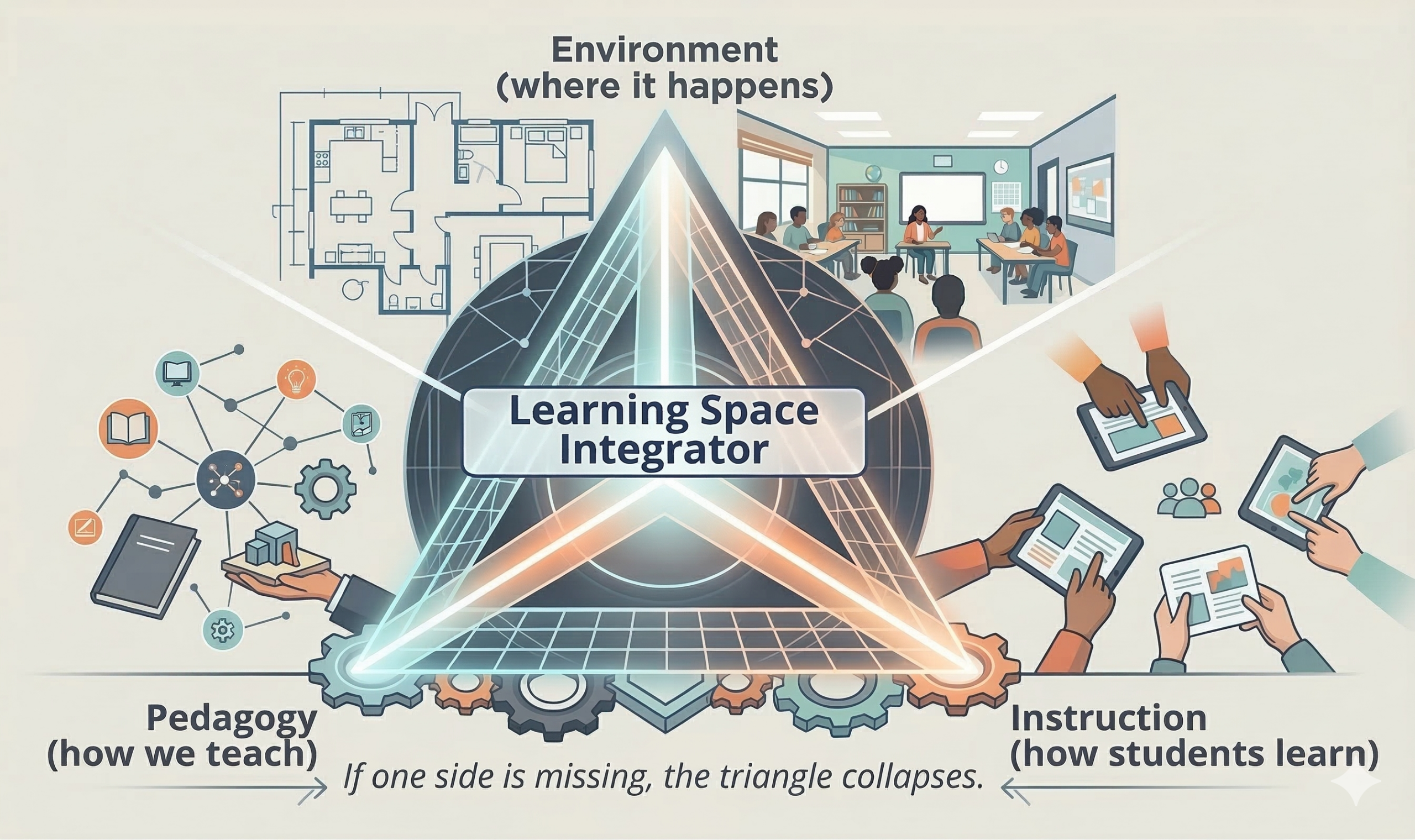
This is where Learning Space Integration becomes more than a concept and where a new role must exist. A Learning Space Integrator (LSI) is not an architect. It’s not a furniture vendor. And it’s not a technology provider.
An LSI is responsible for aligning learning goals, space design, and operational realities into a cohesive system. They work with architects, educators, and district leaders, but their role is fundamentally different. The LSI’s job is to ask and answer questions no one else owns:
- How does this learning model translate into space day one and year five?
- How do architectural decisions, furnishings, and technology reinforce each other?
- How do we design for adaptability rather than locking in assumptions?
- How do we reduce friction for educators while increasing flexibility for students?
Most importantly, the Learning Space Integrator must be selected early and embedded as part of the design team from the beginning. When this role shows up late, the work becomes corrective. When it shows up early, the work becomes strategic.
What Learning Space Integration Really Means
Because this category is still emerging, it is helpful to clarify what a Learning Space Integrator does and does not do. A Learning Space Integrator is not an architect. Architects design the building, ensuring structural integrity, spatial composition, safety, and compliance with building codes.
A Learning Space Integrator is not a furniture vendor. Manufacturers and dealers provide essential products that enable learning activities.
A Learning Space Integrator is not a curriculum consultant. Instructional specialists guide pedagogy, curriculum frameworks, and academic strategy.
Instead, a Learning Space Integrator works across all of these domains. Their role is to ensure that architecture, furniture, instructional practices, and operational systems align with the educational vision of the school.
They ask questions such as:
- What learning behaviors should this environment enable?
- How will educators actually use these spaces throughout the school day?
- How will furniture and spatial design reinforce instructional practices?
- What operational systems must evolve to support the environment being created?
By facilitating these conversations early, Learning Space Integrators help prevent the disconnects that often emerge later in the process. They ensure the final environment reflects both the design intent of the architect and the lived experience of the educators and students who will use the space every day.
Designing for Behavior, Not Just Aesthetics
One of the most important shifts within Learning Space Integration is moving from designing for appearance to designing for behavior. Beautiful spaces matter. They communicate dignity, inspiration, and pride within a community. But effective learning environments must go further. They must intentionally support the behaviors that enable meaningful learning.
Consider a few examples:
- A corridor with integrated seating can become a spontaneous collaboration space between classes.
- A classroom with multiple learning zones allows students to select the environment that best supports their task.
- A central learning commons can encourage interdisciplinary interaction across grade levels.
These outcomes are not accidental. They occur when designers and educators work together to understand how learning unfolds throughout the day. Learning Space Integration ensures those conversations happen before design decisions are finalized.
The Question Architects Should Ask First
If Learning Space Integration is essential to aligning design and learning, then one of the most important questions an architect can ask early in the design process is surprisingly simple: Who will serve as the Learning Space Integrator on this project?

Too often, this role is assumed to exist informally or is introduced late in the process after major design decisions have already been made. When that happens, the opportunity for meaningful alignment has largely passed. Instead, architects and district leaders should intentionally identify the Learning Space Integrator at the beginning of the project.
There are several ways this can be accomplished: Some districts maintain a short list of pre-qualified Learning Space Integrators who have demonstrated experience aligning learning environments with instructional practices. Others choose to solicit the role through a Request for Qualifications (RFQ) process, inviting firms with expertise in learning environments, educational operations, and space planning to participate as part of the design team.
Selecting a Learning Space Integrator early allows them to contribute during the most critical phases of planning, when decisions about space, adjacency, flexibility, and instructional support are still fluid. This timing is essential because the earliest design decisions often have the greatest long-term impact. Once structural layouts, circulation patterns, and core spatial relationships are established, the ability to meaningfully influence the learning environment becomes significantly more limited.
Pinpointing the Exact Moment the Project Goes Off Course
In most school projects, alignment doesn’t disappear dramatically. There isn’t a major conflict or a clear mistake. Instead, it happens quietly during a routine step in the process. Eventually the conversation turns to furniture specifications.
Someone asks a practical question: “What furniture are we specifying?”
On the surface, this seems like a logical next step. The building design is progressing, budgets are being finalized, and furniture selections need to be documented. But if no one on the team is responsible for integrating the learning outcomes with the physical environment, something subtle happens.
The conversation shifts. Instead of asking:
- What learning behaviors do we want to enable?
- How will educators use the space?
- How should the environment flex as teaching evolves?
The discussion becomes centered on products and specifications. At that moment, the project unintentionally moves from an outcome-driven conversation to a competitive product-driven one.
- Architects begin translating spaces into furniture specifications.
- Manufacturers prepare to compete for those specifications.
- Dealers prepare to respond with bids.
When design intent and educational practice are aligned, buildings do more than house learning.
No one is doing anything wrong. In fact, every participant is simply performing their traditional role within the school construction process. This system worked fine when the only decision to make was “Which navy blue student chair should we purchase?” But without a Learning Space Integrator guiding the conversation, the project quietly loses alignment with the original educational vision.
What began as a conversation about how students will learn becomes a competition about which furniture products will be supplied. This is the moment the project stops functioning as a coordinated learning system and starts behaving like a traditional furniture procurement process. And once that shift happens, recovering the original intent becomes extremely difficult.
Why Early Integration Matters
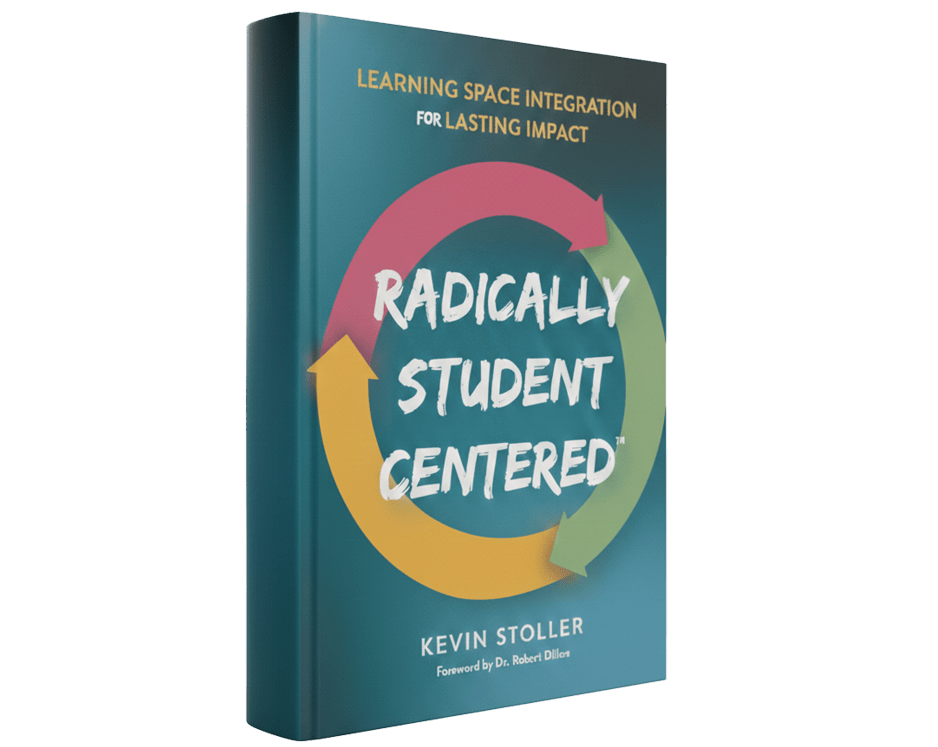
In our new book, Radically Student Centered™, we share the approach that the most successful learning environments begin with alignment around four foundational elements:
Shared Vision: What experiences should students have within the school?
Budget: How will resources support those experiences?
Timeline: How will decisions unfold throughout the project?
Accountability: Who is responsible for guiding each major decision?
A Learning Space Integrator plays a critical role in helping teams establish and maintain alignment across these elements. They help translate educational goals into spatial strategies. They help architects understand how instructional practices influence space usage. They help operational leaders anticipate how the building will function day to day.
Most importantly, they help maintain the focus where it belongs — on the student experience. When this alignment happens early, schools gain several advantages. Design decisions become more intentional. Educators feel greater ownership of the environment. Furniture and spatial layouts support instructional practices rather than competing with them. Operational challenges are identified before the building opens.
The result is a learning environment that works as intended from the first day of occupancy.
To order a copy of the book Radically Student Centered™, visit https://kay-twelve.com/rsc-book/.
From Projects to Learning Systems
School facilities represent one of the most significant investments a community will make in its future. Unlike most educational initiatives, buildings often shape learning experiences for thirty to fifty years. Because of this longevity, school design should not be approached as a one-time project. It should be approached as the creation of a long-term learning system.

Learning Space Integration provides a framework for building that system intentionally. It recognizes that architecture, furniture, instructional practices, and operational systems must work together if learning environments are going to deliver on their promise. For architects and designers, this shift represents a powerful opportunity.
By embracing Learning Space Integration and advocating for the early inclusion of a Learning Space Integrator on the design team, architects can help ensure their work not only inspires communities visually but also empowers the educators and students who will use these spaces every day.
When design intent and educational practice are aligned, buildings do more than house learning. They elevate it. And that is when school design fulfills its true potential.