


The Livonia Early Childhood Center was designed to give young children a strong start through environments that encourage exploration, creativity, movement, and sensory learning. To help bring that vision to life, TMP Architecture specified digitally printed Polyvision CeramicSteel surfaces that serve as both durable teaching tools and interactive design features.
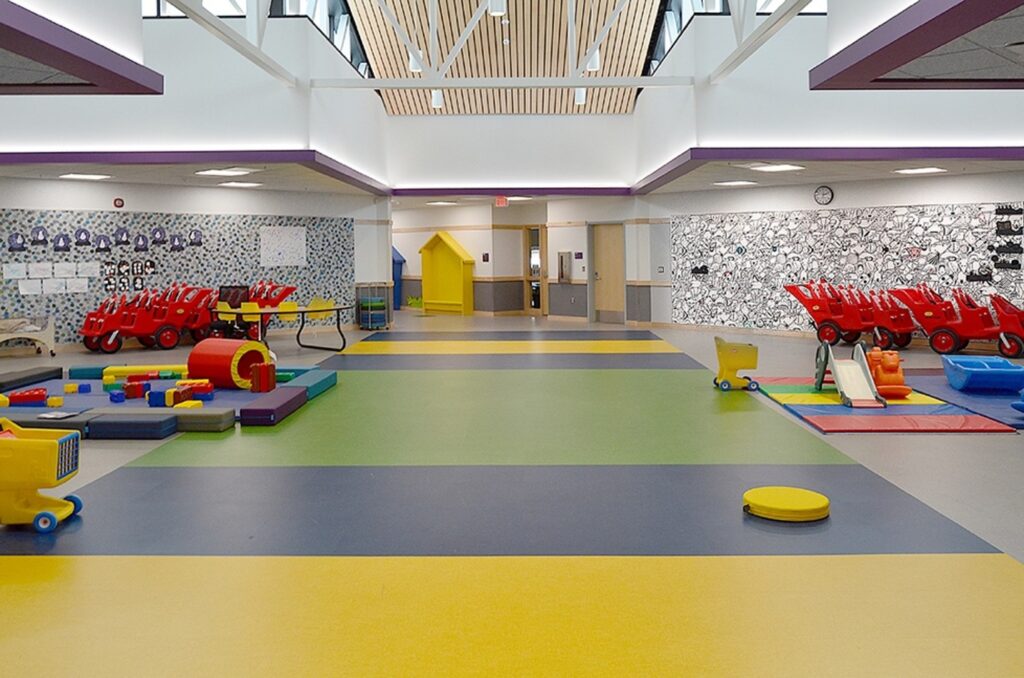
The center, part of Livonia Public Schools in Michigan, opened in August 2024 as a new early learning facility. The approximately 72,000-square-foot building combines new construction with a renovated portion of a former junior high school and includes 29 classrooms, a large gross motor area, support spaces, and more than 60,000 square feet of outdoor play space. The school serves children from infancy through age five, with enrollment of more than 700 students.
Designing for Sensory Learning
The school’s mission emphasizes giving children a strong foundation through sensory learning. That focus shaped the design approach: spaces were planned not only to support instruction, but also to encourage movement, discovery, collaboration, and self-expression during a child’s earliest educational experiences.
Using those goals as a guide, TMP Architecture developed interior finishes that support both learning and everyday use. Classrooms were equipped with framed whiteboards featuring Polyvision’s CeramicSteel surface for focused instruction and collaboration. In shared family areas, the team wanted a more playful, open-ended feature that would invite children and families to interact with the environment directly.
Why Printed CeramicSteel
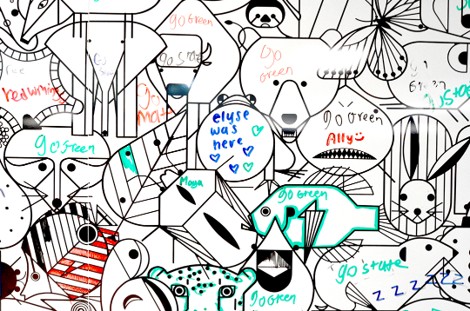
Having used printed CeramicSteel successfully on an earlier Michigan school project, the designers selected it again for its ability to combine visual impact with long-term performance. Polyvision CeramicSteel is a non-porous, durable surface engineered to resist scratching, staining, chemicals, and fire while maintaining consistent writing and erasing performance over time.
The material’s long service life can reduce replacement needs and lower total ownership costs—an important advantage for educational facilities managing tight budgets. CeramicSteel surfaces are also certified to Indoor Advantage Gold and Cradle to Cradle Certified® Bronze standards, supporting the project’s sustainability and indoor environmental quality goals.
A Collaborative Canvas
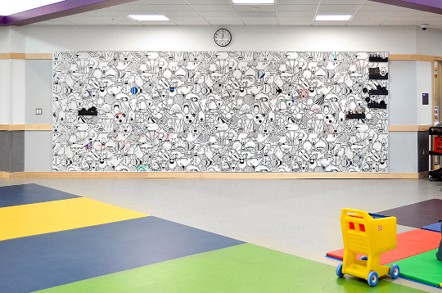
For the featured installation, the team selected Beguiled by the Wild by designer Charley Harper, a whimsical composition of outlined animal forms. The imagery creates a large-scale surface that invites participation: children can color within the shapes, add drawings, attach magnetic pieces, or incorporate words and symbols of their own.
These performance qualities reinforce the broader goals of the project. In a center designed for daily movement, shared use, and early childhood exploration, surfaces must be resilient as well as engaging. By combining interactivity, durability, and ease of maintenance, the printed installation supports both the school’s educational mission and the practical demands of the environment.
Installation and Everyday Use
The graphic was printed in black ceramic ink and fused to the surface during high-temperature processing, allowing the design to become part of the material itself. TMP Architecture specified Polyvision Flow in part for its installation flexibility; panels can be configured vertically or horizontally to suit the design intent and user needs.
At the Early Childhood Center, a vertical application better matched the height and reach of younger students, making the surface more usable in daily learning and play. TMP Interior Designer Lauren Bush noted that the client was concerned about seam visibility and long-term performance with more seams than a standard horizontal application; using Polyvision Flow boards resolved those concerns.
CeramicSteel’s functionality extends beyond writability. Its magnetic surface allows teachers and students to attach materials with standard magnets, adding flexibility for display and instruction. The non-porous finish also supports routine cleaning and disinfecting, a valuable characteristic in high-traffic educational settings.
Project Impact
These performance qualities reinforce the broader goals of the project. In a center designed for daily movement, shared use, and early childhood exploration, surfaces must be resilient as well as engaging. By combining interactivity, durability, and ease of maintenance, the printed installation supports both the school’s educational mission and the practical demands of the environment.
At Livonia Early Childhood Center, printed Polyvision CeramicSteel shows how material selection can do more than meet technical requirements. Here, the surface helps shape an environment where design actively supports learning — encouraging sensory engagement, creativity, and collaboration while standing up to the demands of everyday school life.