


For more than a century, Whitney Brothers has helped shape environments where young children learn, play, and grow. Founded 122 years ago, the company has built a longstanding reputation in early childhood furniture and learning spaces, particularly within private education settings. Now, under new leadership and a new ownership model, Whitney Brothers is entering its next chapter.
Essentials recently sat down with President & CEO Scott Kroeger to discuss his journey to Whitney Brothers, the company’s transition to employee ownership, and the opportunities and responsibilities that come with leading a legacy brand into its next chapter. Drawing on experience across public companies, entrepreneurship, and employee-owned organizations, Scott brings a thoughtful perspective on building businesses that pair sustainable growth with meaningful purpose.
From Public Markets to Purpose-Driven Manufacturing
Kroeger’s career path has taken several turns, from leadership roles in large public companies to entrepreneurship and employee-owned manufacturing, before arriving at Whitney Brothers. “My career had largely been in public company environments,” Kroeger explains. “Over time, I became increasingly interested in businesses where there was a more direct connection between people, purpose, and long-term value creation.”
That interest led him to employee ownership and eventually to Whitney Brothers. At the time, the company was preparing for a leadership transition following 10 years under the stewardship of former owner Mike Jablonski. As the business explored its future, Empowered Ventures, a 100% employee-owned holding company, emerged as the right fit in January 2025. For Kroeger, the opportunity represented something unique: joining an established company with deep roots while helping shape its future.
Introducing Employee Ownership
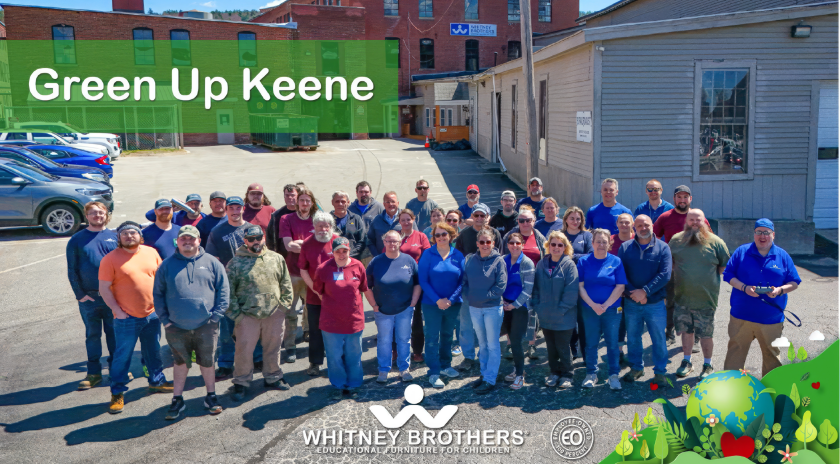
The transition marked a significant shift for Whitney Brothers — from family ownership to employee ownership. Kroeger emphasized that the model differs from traditional equity participation programs. Employees do not purchase shares; instead, ownership benefits are funded entirely by the company and structured to create long-term value, similar to retirement-based wealth building.
What drew me to Whitney Brothers was the idea that what we build ultimately supports children and learning. That’s meaningful work.
While Whitney Brothers already had a strong culture in place, helping employees understand what ownership meant in practice required intentional communication and education. “There was excitement, but also a learning curve,” Kroeger says. “People needed time to understand what ownership means and how they connect to the company’s long-term success.” That process became tangible when employees received their first ownership certificates last year, an important milestone in making the transition real for the workforce.
Leading Through Listening
Although brought in to guide the company’s next phase of growth, Kroeger’s initial focus was not rapid change. Instead, he spent his first months listening. “I wanted to understand the business, understand the team, and understand what had made Whitney Brothers successful for so long,” he says.
Rather than rebuilding leadership from the ground up, Kroeger chose to work largely with the existing team, identifying opportunities to strengthen capabilities while preserving institutional knowledge. That philosophy aligns closely with his broader leadership framework: R.E.A.L. The acronym stands for Respect, Empathy, Accountability, and Learning, four principles Kroeger uses to guide decision-making and team culture.
- Respect creates trust.
- Empathy builds connection.
- Accountability drives results.
- Learning encourages continuous improvement.
Together, the framework is intended to create an environment where employees feel empowered to contribute while remaining focused on growth.
Growing Without Losing Identity
As Whitney Brothers looks ahead, Kroeger sees opportunity in balancing stewardship with expansion. The first priority is maintaining the company’s position and reputation within the private education market that has defined much of its history. At the same time, the company is pursuing broader growth opportunities including expanding its presence in public education and increasing geographic reach beyond its traditional Northeast footprint.
Product innovation is also central to the strategy. Kroeger described a structured development approach that incorporates ongoing customer feedback throughout the process, ensuring new offerings remain closely aligned with educator and learner needs.
Underlying that strategy is a continued focus on the company’s mission. “What drew me to Whitney Brothers was the idea that what we build ultimately supports children and learning,” Kroeger says. “That’s meaningful work.”
Under Kroeger’s leadership, Whitney Brothers continues to expand its impact while honoring more than a century of dedication to children, educators, and the learning environments that shape their success. As Whitney Brothers enters its next era, the company’s approach appears rooted in continuity rather than disruption — preserving what has made the brand successful while creating new opportunities for employees, customers, and the markets it serves.