


When we hear the word “clutter,” we often think about cleaning up or housekeeping. But in a classroom, clutter is about much more than keeping things neat. What students see, hear, move around, find, and put away throughout the day can affect their focus, comfort, independence, and ability to learn. A clutter-free classroom does not need to feel empty or sterile. It should feel organized, predictable, welcoming, and ready for learning.
When Everything Demands Attention
Our brains cannot fully process everything we see at the same time. Colors, words, pictures, supplies, furniture, and movement all compete for attention. When too many things are calling out to students, it can take longer to find what matters. That means students may use valuable mental energy sorting through the environment instead of listening to directions, solving a problem, or completing a task.
One study with kindergarten students helps bring this idea to life. Researchers Fisher, Godwin, and Seltman found that children in highly decorated classrooms were more distracted, spent more time off task, and showed smaller learning gains than they did in a simpler classroom. Students were off task about 40 percent of instructional time in the highly decorated room, compared with 28 percent in the less distracting space. This matters for young learners because they are still developing the ability to tune out information they do not need.
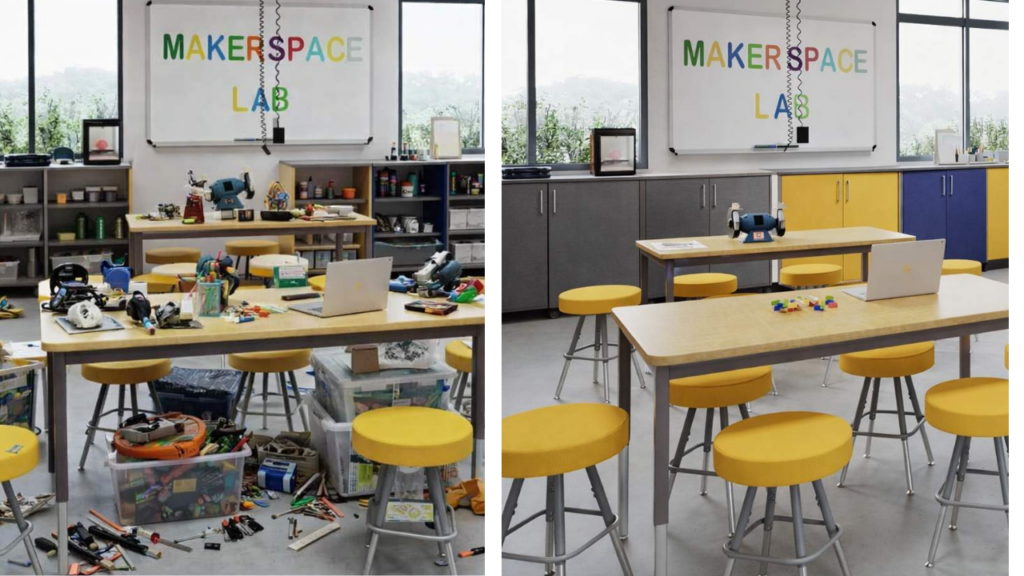
The goal is balance. The classroom is not simply a backdrop for learning; it is an important part of the learning experience. Students should see themselves, their work, and their community reflected in the space. At the same time, educators and designers share the responsibility of evaluating the environment and being mindful of what is displayed, where it is placed, and how it may support—or compete with—student learning.
An Issue of Inclusion and Access
Clutter can affect every student, but for some learners it can severely impact their ability to focus and learn. Students with ADHD often benefit when distractions are reduced, and organization is built into the room. Clear routines, dependable locations, and easy-to-understand storage can help students focus and manage materials.
For autistic students and learners with sensory-processing differences, a typical school day can include a great deal of visual, auditory, and physical input. They are expected to filter all of it while listening, working, and interacting with others. Difficult sensory experiences at school have been connected to distraction, anxiety, distress, and lower participation. Visual clutter deserves special attention because it is both common and something we can change.
Trauma-informed design points us in the same direction. Students who have experienced trauma often benefit from spaces that feel safe, supportive, inclusive, and predictable. A chaotic or visually noisy room may make that harder. Consistent routines, calming tools, movement opportunities, and a quiet place to reset can help students regulate and return to learning.
Designing the Classroom with Purpose
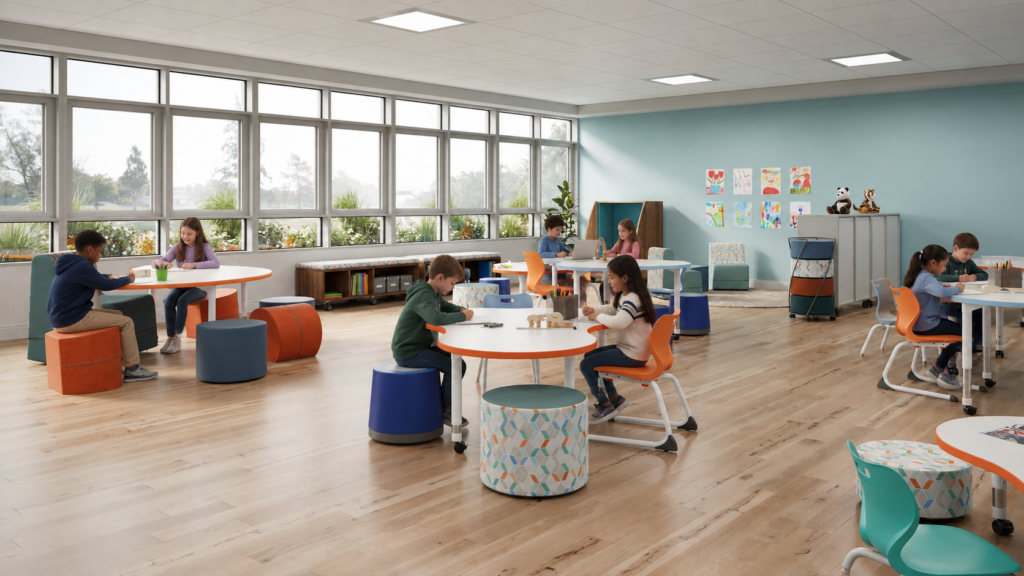
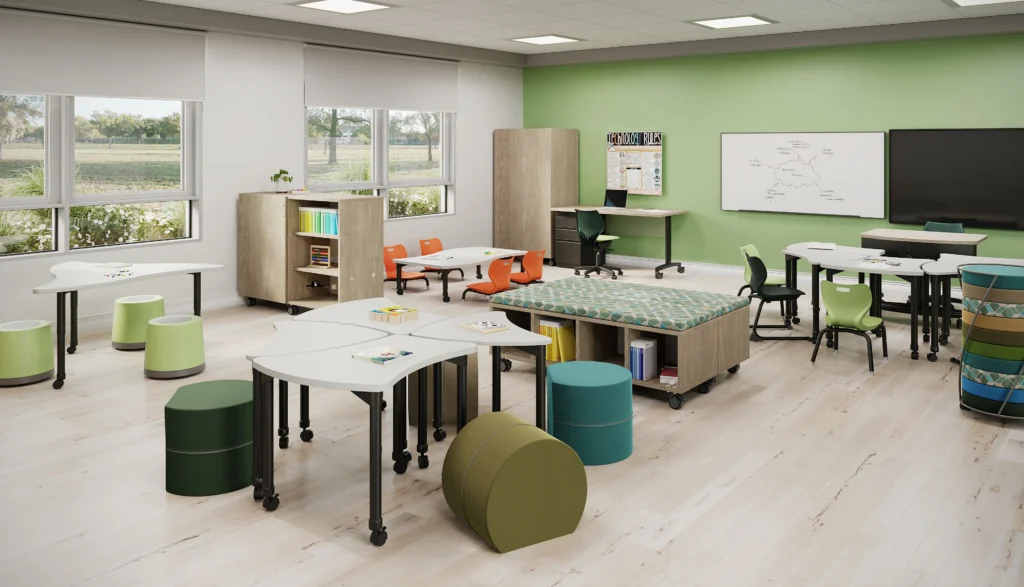
A neuroinclusive classroom makes it easy to understand where to look, where to go, and where things belong. The main teaching wall should highlight current, useful content. Displays, instruction, and storage do not all need to compete on the same wall. Whole-group learning, small-group work, projects, teacher support, and regulation areas should have recognizable locations and storage that fits each activity. Clear walking paths and familiar visual cues make the room easier to navigate.
Good storage should support executive functioning, not simply hold the greatest number of items. Colored bins, clear labels, and obvious return locations can help students who struggle with planning, attention, sequencing, or managing materials. Shared supplies can be placed where groups use them, so collaboration does not create piles on every table.
The work does not end when the classroom opens. Teachers and design teams can conduct post-occupancy observations to evaluate the following:
- How long do students spend finding materials?
- Where does clutter collect?
- Does storage create traffic jams?
- How much setup time do teachers need?
- What do students say about the space?
Those insights can guide small changes and keep the focus on what truly helps students learn.
The takeaway: The materials are not the problem. What matters is how the classroom asks students to find, understand, use, and return them. Purposeful organization makes a space easier to understand, more accessible, and more welcoming. Thoughtfully planned storage reduces visual noise, supports calm and collaboration, and gives students more independence—and more space to learn.
Selected sources
- Fisher, A. V., Godwin, K. E., & Seltman, H. (2014). Visual environment, attention allocation, and learning in young children.
- McMains, S., & Kastner, S. (2011). Interactions of top-down and bottom-up mechanisms in human visual cortex. The Journal of Neuroscience, 31(2), 587–597.
- McDowell, N., & Budd, J. (2018). Classroom clutter and learning experiences for students with cerebral visual impairment. Journal of Visual Impairment & Blindness, 112(3), 248–260.
- Meng, X., Zhang, M., & Wang, M. (2023). Effects of school indoor visual environment on children’s health outcomes: A systematic review. Health & Place, 83.
- CAST. (2024). Universal Design for Learning Guidelines 3.0. Additional guidance referenced: CDC, SchoolSafety.gov, and the U.S. Access Board.