


Most districts replace cafeteria tables once every ten to fifteen years. The person running the purchase has probably never run one before and will not run another for a decade. The decision goes through a committee, gets reviewed by the business office, and is then lived with every day by food service and custodial staff who were not in the room when it was made.
These are the questions worth asking before the first vendor call, and what a useful answer sounds like.
How long should a cafeteria table last?
Ten to fifteen years of daily use is the working expectation for a commercial grade table in a K-12 cafeteria. That lifespan is determined by materials and construction. A table reaches year fifteen because of the gauge of the steel, the quality of the welds, the substrate under the top, and how the edges are sealed against daily cleaning.
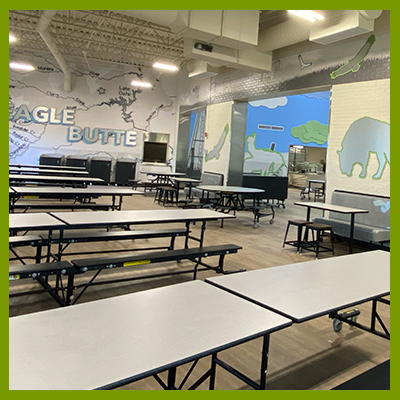
American made furniture, built on proven materials and manufacturing processes, is what delivers that. Palmer Hamilton has been building in this category since 1946, and the tables that reach year fifteen are the ones where the decisions were made at the frame rather than at the surface. The frame carries the structural load on its own, which is why the table holds its shape through years of folding, rolling, and storage.
What actually drives the price?
Five variables move a cafeteria table quote more than anything else.
- Table size and shape, whether rectangular, round, or a shaped configuration
- Top material, usually laminate or solid surface
- Seating style, whether attached benches, detached benches, stools, or chairs
- Mobility, whether the table folds and rolls or stays fixed
- Finish, color, and custom logo tops
As a general rule, a laminate top with attached benches sits at the economical end of the range. Mobility, premium surfaces, and custom color move a quote up from there.
Ask your dealer for options at a few different price points. That makes it easier to find the package that fits your goals for the space and your budget.
Which type of table fits which room?
Rectangular tables with attached benches are the most common configuration in K-12 and deliver the highest seating density per square foot. They also remove the chair management problem that consumes staff time at the end of every period.
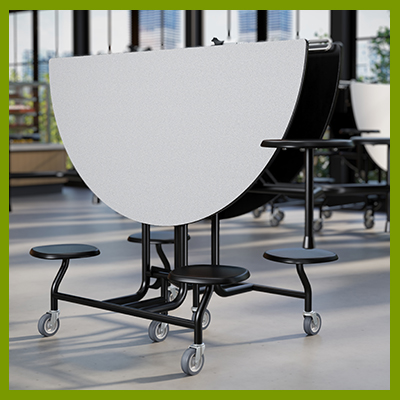
Rectangular tables with detached seating give older students more flexibility and can simplify accessible positioning. The cost is floor space and more pieces to track.
Round tables change the social dynamic of the room. They work well in elementary settings and avoid the isolation students feel at the ends of a long bench.
Folding and mobile tables are not a convenience feature if the cafeteria also serves as an auditorium, a testing center, or a community space. They are the only configuration that lets one room do all of it. Look for a table that one staff member can fold and move alone. That is worth testing in person rather than taking on a spec sheet. We design Palmer Hamilton mobile tables around a single operator, because a table that takes two people to move tends to stay where it is.
Wall pocket tables answer the same need without the storage problem, folding into a recess in the wall so the floor clears completely and no one has to find somewhere to put the tables.
Booth and bench seating defines zones inside a larger dining room and works well along perimeter walls.
What separates a durable table from one that only looks durable?
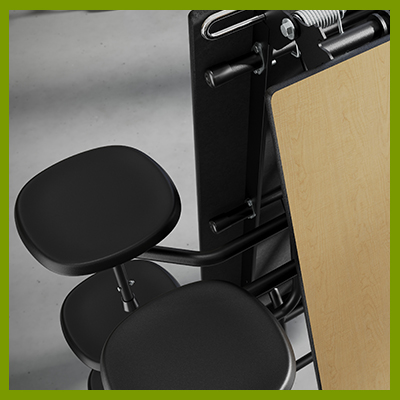
Six things are worth confirming on paper.
- A welded steel frame that carries the load independently of the tabletop
- Leg glides that will not mark floors and can be replaced when they wear
- Tops rated for commercial food service rather than light duty laminate
- Continuous bench support rails rather than spot supports
- Stainless or coated fasteners
- Powder coat finish on all metal
Then read the warranty rather than the number in the headline. What is covered, for how long, and whether service is handled locally or requires shipping components back to the manufacturer.
How much cleaning time does the specification cost?
More than most buyers expect. Custodial staff clean these tables between every period, sometimes with five minutes to do it.
Laminate rated for food service resists stains and cleans quickly with school safe sanitizers. Solid surface holds up better to heavy scrubbing and stronger chemicals. Either can work in a school. The difference that shows up in daily practice is edge sealing and joint construction, because gaps and unsealed edges collect debris and take time to clear.
Color matters too. A dark solid laminate shows fingerprints and light scuffs that a patterned or lighter top hides, because there is no pattern to break up the surface. The material is no less durable. A matte or textured finish shows less than a gloss, and a solid core laminate carries color through the full thickness, so a chipped edge does not expose a light line.
Confirm that the top and the frame finish are compatible with the sanitizers your food service team already uses. A table that needs its own cleaning products adds cost every year it is in the building.
What does ADA compliant cafeteria seating require?
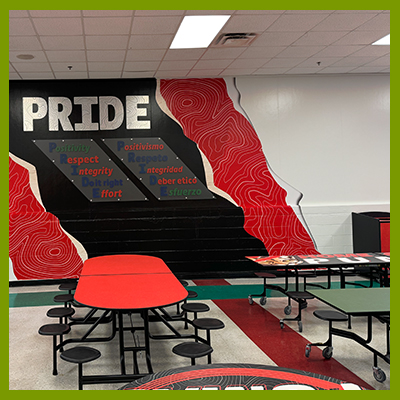
Accessible seating belongs in the layout from the start rather than added at the end. In practice that means open end or removable bench sections that let a wheelchair pull up to the table, and enough knee clearance under the surface. For adults, that means at least 27 inches of knee clearance and a surface height between 28 and 34 inches. Where tables serve children 12 and younger, the standards allow lower dimensions: a surface height of 26 to 30 inches, with at least 24 inches of knee clearance. The full requirements are published in the ADA Standards for Accessible Design at ADA.gov.
The specification detail worth pushing on is whether accessible configurations come from the same product family as everything else in the room. When they do, an accessible seat looks like every other seat. When they do not, it looks like an accommodation, and students notice. It is a question worth putting to any manufacturer. Palmer Hamilton builds accessible configurations within the same product families, so the room reads as one room.
How many seats should the room have?
This is the wrong first question. The better ones are how students move from the serving line to a seat, how the room clears at the end of a period, and how quickly tables can be wiped down and reset for the next group.
A room with slightly fewer seats and clear movement will turn over faster than a packed room where students are shoulder to shoulder. Count capacity after the layout works, not before.
What to confirm before you sign
- Tops rated for commercial food service
- Seating style decided: attached, detached, or mixed
- Room flow mapped, including serving line, traffic paths, tray return, and trash receptacles
- Table placement checked against the flow, so aisles stay clear at peak
- Accessible configurations built into the layout
- Mobility decided if the room serves more than one purpose
- Warranty terms in writing, including parts coverage
- Cleaning chemical compatibility verified with food service
To see how these decisions come together in real schools, watch videos of cafeteria spaces Palmer Hamilton has designed and built in our video library