


Today, in a time where education is rapidly transforming to meet increasing demands of every kind, the concept of heutagogy — or self-determined learning — is emerging as a powerful framework. Heutagogy spotlights: Learner Autonomy, Capacity Building, and Capability Development, representing a significant necessary evolution beyond traditional teaching methods.
While attention has been previously devoted to curriculum, technology, and other educational innovations, one critical element is often overlooked: the physical environment. The design of learning spaces plays a pivotal role in enabling or constraining self-determined learning that heutagogy seeks to foster.
This article explores the intersection between physical space design and heutagogical mastery — examining how thoughtfully configured environments can transform educational practice and support the development of autonomous, capable learners.
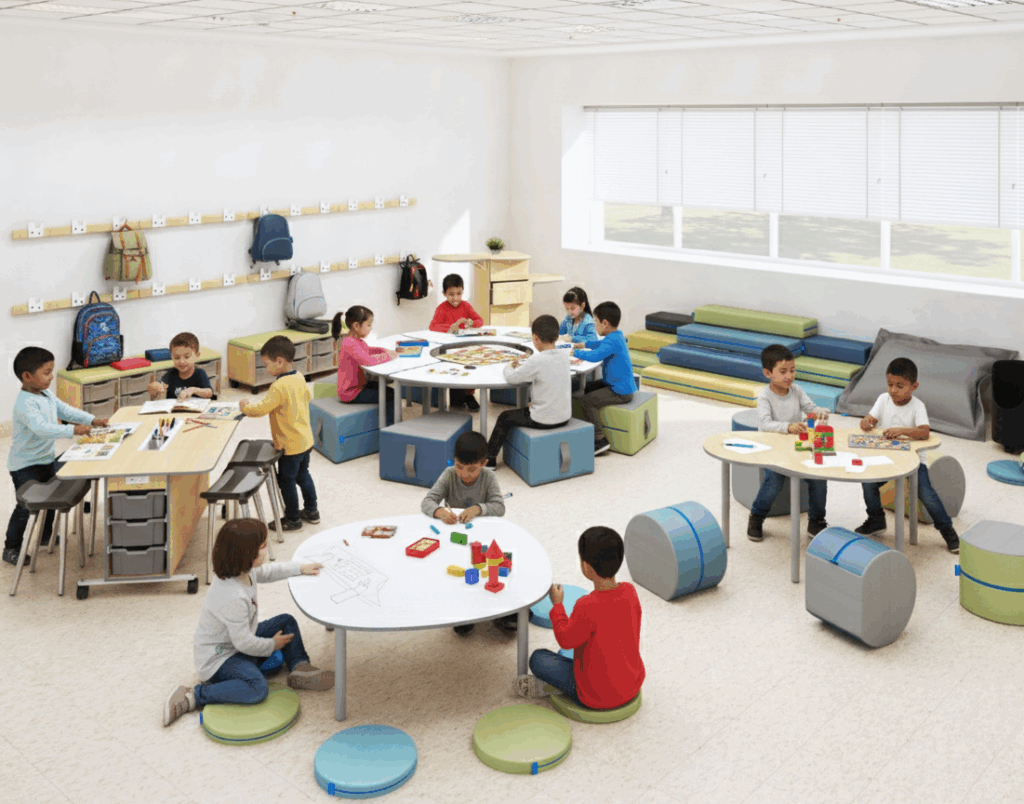
What is Heutagogy?
Heutagogy, stemming from the Greek “heuriskein” meaning “to discover,” was first introduced by Stewart Hase and Chris Kenyon in the early 2000’s as an extension of Malcolm Knowles’ andragogy. While pedagogy emphasizes teacher control and andragogy introduces learner autonomy, heutagogy empowers learners not only to direct their learning but also to define what and how they learn, shifting the focus of control firmly into learners’ hands.
Core Principles
- Human Agency as Emphasis: Recognizing that learners actively contribute to their education through reflection, motivation, and self-determination.
- Capability as Priority: Preparing learners not just to perform specific tasks but to adapt their knowledge creatively to a wide variety of situations.
- Double-Loop Learning Approach: Individuals critically examine not only their actions but also the underlying assumptions guiding their actions. This metacognitive approach gives learners the opportunity to grow in reflective skill sets allowing for internal and external growth.
- Non-Linear Pathway Celebrations: Heutagogy acknowledges that authentic learning rarely follows predetermined sequences. By nature, heutagogical learning isn’t necessarily linear or planned but parallels how people best learn outside formal school settings.
Within a heutagogical model, teachers serve as facilitators or coaches rather than primary knowledge sources, creating conditions where the learning community can explore, question, and construct personal learning journeys.
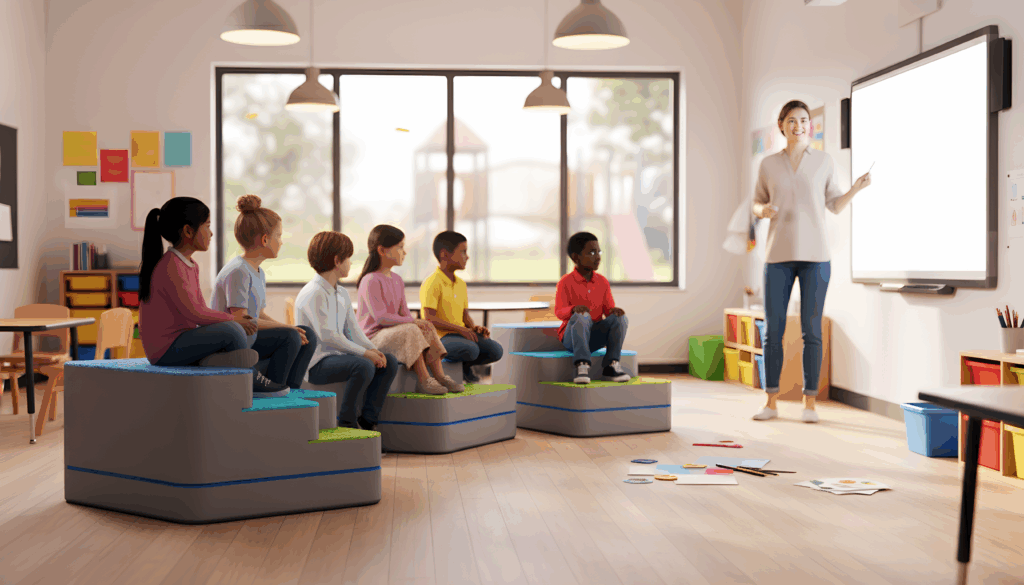
Connection Between Physical Space and Pedagogy
Let’s be real — the connection between physical space and pedagogy is not a new concept. Although there are a great number of new buzz words zooming around educational development and design communities, the acknowledgement of power physical space has regarding pedagogy originated long before this article.
Built Pedagogy is a perspective introduced by Torin Monahan around 2002 in a paper titled: Flexible Space & Built Pedagogy based on ideas that had been percolating since the 1970’s. Concepts such as “open-plan school experimentation” highlighted flexibility and interest-based learning. Built Pedagogy is a design-centered concept which promotes connection to pedagogical practices for the betterment of the environment as a whole. It suggests that physical spaces are not neutral — they tacitly embody specific pedagogical practices and promote learner experiences and behaviors.
Research Demonstrates this Connection Empirically
A University of Salford study analyzing 153 classrooms across 27 elementary schools found that classroom design elements accounted for 16 percent of variation in learners’ [students’] academic progress. Factors assessed, including lighting, acoustics, temperature, furniture arrangement, and opportunities for personalization all contributed to learning outcomes.
Designing 22nd century learning spaces is a massive opportunity to finally connect design principles with educational methodologies efficiently and effectively. Now, more than ever, the world of education needs this connection to be actualized. Industrial-facing, traditional floor plans optimize instructor transmission. This arrangement fundamentally conflicts with heutagogical principles, which require flexibility, choice, and opportunities for the learning community to direct their own learning processes.
So how does this happen?
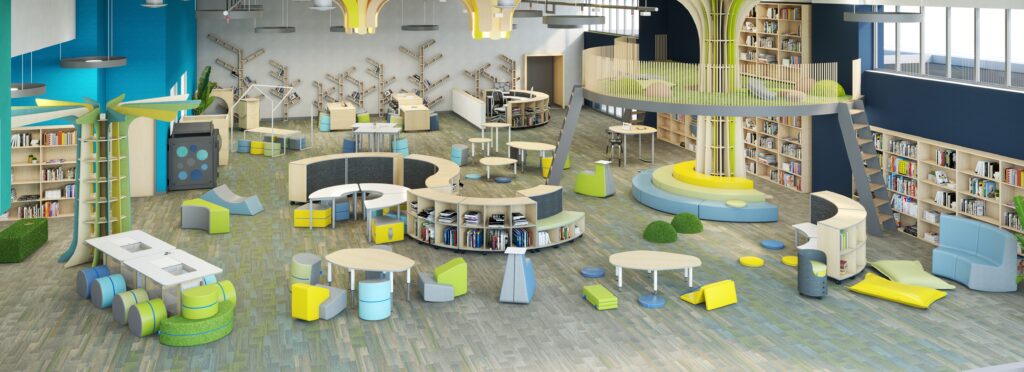
4 Key Design Principles for Heutagogical Spaces
- Flexibility
Perhaps the most critical design principle for heutagogical environments is that once individuals are enabled, they are better able to self-direct their learning. This suggests that physical flexibility directly enables cognitive and behavioral autonomy which has been proven via activities that promote spatial tetris or the practice of rapid mental rotation and translation of shapes. Critically, flexibility extends beyond furniture to include temporal and spatial dimensions.
Professor of Education, Leah McCoy, of Wake Forest University states, “Spatial visualization is partly inherent ability, but partly learned expertise. Some researchers identify spatial skill as necessary for successful problem solving, and it’s often used alongside mathematics skills and verbal skills.”
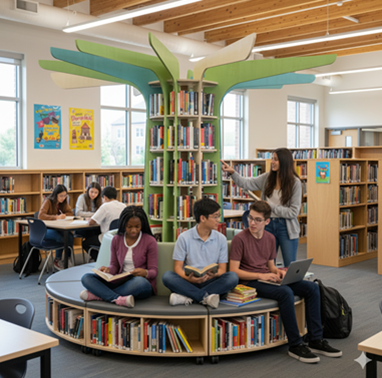
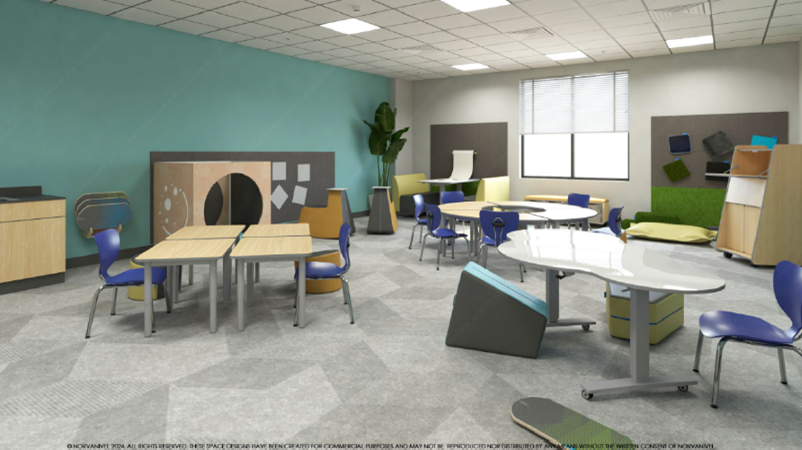
Flexible spaces incorporate moveable furniture, reconfigurable zones, multi-purpose areas, and light, medium weight, and heavy components. Heutagogical learners benefit from choosing not only how they arrange their physical space but also when and where learning occurs, whether in formal classrooms, informal learning zones, or outdoor environments.
- Learning Zones
Examples of Learning Zones include quiet spaces, teaching corners, small group or peer discussion areas, makerspaces, and learning pods.
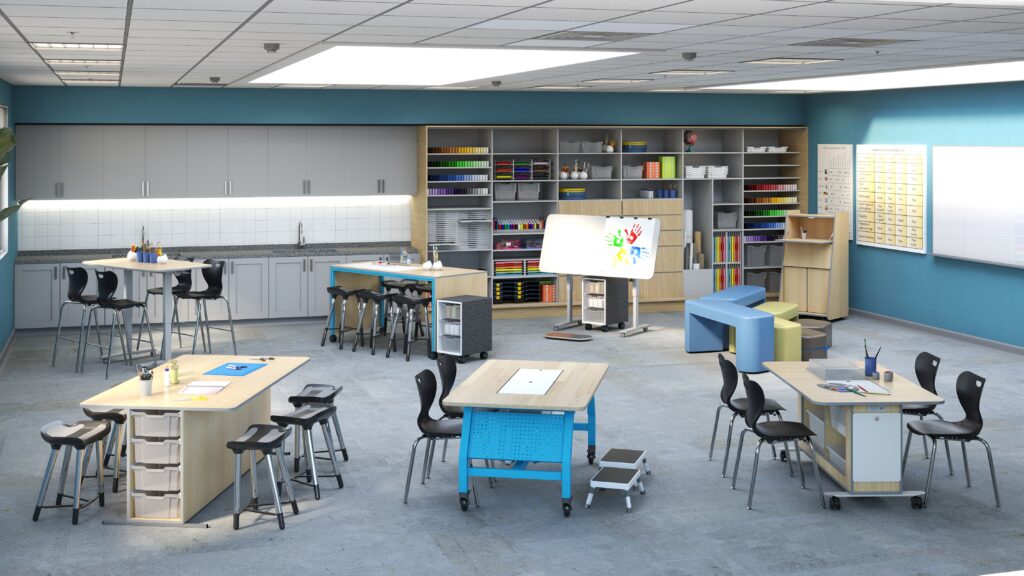
At Florence Roche Elementary School in Massachusetts, different zones have different functions — teacher corners for small group instruction, quiet areas with dim lighting and white noise for focused work, and small group areas with whiteboards for collaborative activities.
This zoning approach aligns with heutagogical principles by providing students with choices about their learning environment. An individual might begin research in a quiet zone, move to a collaborative space for peer discussion, then transition to a makerspace for hands-on experimentation — all self-determined based on their learning needs at any given moment. Learning pods or semi-enclosed areas offer additional benefits, providing spaces for small-group instruction while minimizing distractions. These intimate environments support the deep reflection and metacognition central to heutagogical practice.
- Accessability
The most transformative aspect of heutagogical design is enabling individuals to exercise agency over their environment. The community is given autonomy to choose their approach and the resources they need, leading to deeper understanding of material. This autonomy extends to physical space — individuals who can personalize their learning areas, select appropriate furniture, and modify their surroundings develop stronger ownership of their learning.
Research shows individuals do better in certain subjects, particularly mathematics, when they can personalize their learning space, giving them a sense of ownership. At Acland Burghley Sixth Form in London, soft furnishings and modular seating remained in pristine condition months after installation, demonstrating that students respect spaces they feel valued in.
- Technology Integration
While physical space provides the foundation, thoughtful technology integration amplifies heutagogical possibilities. Innovative technology infrastructure makes it possible for any space to become an active learning zone and to extend learning beyond traditional classroom boundaries. However, technology should enhance rather than replace physical space considerations. Charging stations, display surfaces for sharing work, and areas for both individual and collaborative digital work all require careful spatial planning. The goal is creating seamless integration where learners can fluidly move between analog and digital resources as their learning needs evolve.
Practical Advice
Start with Learner Input: The learning community is the best source of information about what needs changing in learning spaces. Begin by asking two key questions: What supports or hinders your learning? Conduct these audits regularly — every two weeks — to ensure the space continues serving needs as they evolve.
Implement Incremental Changes: Not everyone has access to unlimited resources or complete renovation budgets. Focus on purposeful changes: rearrange existing furniture to create zones, reduce visual clutter that becomes noise, add flexible seating options even if limited, and create designated spaces for different learning modes. The very first thing to focus on in creating a successful modern learning space is the goal — considering the purpose, appearance, and learning activities that will occur. This foundation guides all subsequent design decisions.
Balance Structure and Freedom: While heutagogy emphasizes learner control, individuals still need scaffolding, especially when transitioning from more traditional approaches. Design spaces with clear zones and purposes while allowing flexibility within parameters. Provide guidance on how to use different spaces effectively while encouraging experimentation. A heutagogical approach requires flexible curriculum that considers learners’ questions, motivations, and thinking shifts. The physical space should mirror this flexibility.
Consider the Full Learning Ecosystem: Modern learning spaces stem beyond classroom walls — learners spend time in dining halls, study areas, libraries, and playgrounds, all playing crucial roles in learning and development. Consider every space as a potential learning environment. Informal learning areas often provide rich opportunities for self-determined exploration.
Address Human Needs Holistically: Learning environments that support human needs strengthen learning — rooms too cold, with flickering lights, or uncomfortable furniture become distracting. Attend to lighting quality, temperature control, acoustic treatment, and ergonomic furniture. These foundational elements enable the cognitive work heutagogy requires.
Foster Collaborative Learning Opportunities: One way to ease the transition into heutagogy is encouraging collaboration in the classroom, as the heutagogical approach makes it easy for individuals to work together sharing knowledge and reflecting on progress. Design spaces that facilitate both collaboration and independent work, with easy transitions between modes.
Understanding Roles
The Teacher as Metacognitive Coach
One of the most critical insights about heutagogy is this: self-direction isn’t innate. It’s learned. And that means someone needs to teach it. This is where teachers become metacognitive coaches. They explicitly teach students how to learn — how to set goals, monitor their own understanding, recognize when they’re stuck, select appropriate strategies, and reflect on their progress. These executive function skills are the foundation of genuine self-determination.
The Teacher as Guide and Resource
Just because learners have agency doesn’t mean they have all the answers. Educators in heutagogical settings serve as expert guides who help individuals navigate complexity, identify quality resources, and make connections they might not see independently.
This is where teachers become Guides and Resources: When a learner is pursuing an inquiry, the educator might suggest a resource they hadn’t considered or point out a connection to previous learning. When an individual is stuck, the educator asks questions that help the learner diagnose the problem rather than simply providing the solution. When the learning community is ready to go deeper, the educator knows what the next challenge should be. The difference is that this guidance is responsive to student direction rather than predetermined and delivered to everyone on the same schedule.
The evidence is clear: physical environment significantly impacts learning outcomes.
The Teacher as Cultivator of Culture
Heutagogical learning requires a particular kind of classroom culture — one where mistakes are learning opportunities, where individuals trust themselves and each other, where curiosity is valued over compliance, and where the process of learning is just as important as the product.
This is where teachers become Cultivators of Culture: Educators cultivate this culture through their daily words and actions. They normalize struggle by sharing their own challenges and failures. They celebrate when learners try something difficult, regardless of the outcome. They facilitate peer feedback that’s constructive rather than critical. They model reflection and metacognition as ongoing practices, not just end-of-unit activities. Educators set the tone that makes heutagogical learning possible — or impossible.
Conclusion
The importance of physical space design in achieving heutagogical mastery cannot be overstated. (Saying it louder for the people in the back!) While heutagogy emphasizes internal qualities — learner agency, metacognition, capability development — these dispositions emerge and flourish within environments that either constrain or enable their expression. Thoughtfully designed learning spaces serve as silent partners in the educational enterprise, communicating values, facilitating interactions, and providing the conditions necessary for self-determined learning to thrive.
If we aspire to develop autonomous, capable, lifelong learners prepared for complex workplace environments, our learning spaces must embody those aspirations through flexibility, choice, diverse learning zones, and opportunities for agency/accessibility. The evidence is clear: physical environment significantly impacts learning outcomes. The question facing architects, designers, educators, business officials, and administrators — is not whether space matters, but how deliberately we will design spaces aligned with our pedagogical commitments. For those pursuing heutagogical mastery, the answer must be: very deliberately indeed.
By attending carefully to the physical environments where learning occurs, educators can create conditions where self-determined learning becomes not just possible, but inevitable — where individuals naturally develop the capability, autonomy, and lifelong learning dispositions that characterize heutagogical success.
References
- Agonács, N., & Matos, J. F. (2019). Heutagogy and self-determined learning: A review of the published literature on the application and implementation of the theory. Open Learning: The Journal of Open, Distance and e-Learning, 34(3), 223-240.
- Barrett, P., Zhang, Y., Davies, F., & Barrett, L. (2015). Clever classrooms: Summary report of the HEAD project. University of Salford.
- Blaschke, L. M. (2012). Heutagogy and lifelong learning: A review of heutagogical practice and self-determined learning. International Review of Research in Open and Distance Learning, 13(1), 56-71.
- Blaschke, L. M., & Hase, S. (2016). Heutagogy: A holistic framework for creating twenty-first-century self-determined learners. In B. Gros, Kinshuk, & M. Maina (Eds.), The future of ubiquitous learning (pp. 25-40). Springer.
- Dillon, R., & Hare, R. (2016). The space: A guide for educators. Corwin Press.
- Hase, S., & Kenyon, C. (2000). From andragogy to heutagogy. Ultibase Articles.
- Hase, S., & Kenyon, C. (Eds.). (2013). Self-determined learning: Heutagogy in action. Bloomsbury Academic.
- Moore, R. L. (2020). Developing lifelong learning with heutagogy: Contexts, critiques, and challenges. Distance Education, 41(3), 381-401.
- PowerSchool. (2025). Heutagogy explained: Self-determined learning in education. Retrieved from https://www.powerschool.com/blog/heutagogy-explained-self-determined-learning-in-education/