

In 2026, as K-12 education shifts toward increased state-level authority, intentional screen-time management, and a stronger focus on career-readiness, smart EdTech solution providers should fundamentally rethink how they partner with Educational Service Agencies (ESAs) to scale their impact.
Oftentimes overlooked, ESAs are an essential part of the U.S. K12 ecosystem. In many ways they function as the glue that connects State Education Agency (SEA) objectives and funding to Local Education Agency (LEA – aka schools) needs and programs. They service all types of LEAs (think “school choice”) with instructional resources, professional development, and in some cases, cost-saving competitive procurement channels for vetted solutions.
When it comes to education in the United States, clearly one size does not fit all. This statement is even more true when one looks at ESAs. There are 904 ESAs nationwide with an approximate annual budget of nearly $15B+ (U.S. Department of Education data indicates approximately $14.7B out of the overall estimated $159.5 billion total appropriations for education for FY2026 or just about 10% of the overall K12 budget), so the potential of this market is huge and worth unraveling the mystery around how they function to develop your own go-to-market plan.
What Exactly is an Educational Service Agency?
If you find yourself asking that question, rest assured that you are not alone. Let’s be clear — there is no one, common model, though they are all similar, each state approaches these essential support services in different ways, and in some states in multiple ways! Understanding the landscape for targeted states is a key element in a winning strategic plan.
First and foremost, ESAs are established by state laws, and while there are 6 states that directly manage the typical ESA services at the state Department of Education level, there are 44 states with active ESAs representing roughly 82% to 86% of the country. This collective network of ESAs represents and services an unparalleled portion of the American school system:
- 11,700 (79%) of the public school districts;
- 22,710 (83%) of the private schools;
- 2,160,955 (79%) certified teachers and;
- 2,018,888 (80%) non-certified school employees, and;
- 40,732,954 (80%) public and private school students
While Educational Service Agencies (ESAs) nationwide share a core mission to pool resources and support local districts, their governance, funding, and legal authority vary significantly. Never assume you understand an ESA’s operations without conducting local research; even within a single state, individual agencies differ based on state law, geography, and local demographics, ranging from unique rural vs. urban vs suburban needs, to partnerships with local industry and higher education.
Nationwide, this landscape is equally diverse. Some states have well-established ESA structures that assist with federal funding, while others offer optional non-mandated resources. Some agencies even compete with each other by offering “cross-contracting” options, a practice that, while flexible, can complicate vendor relationships. Ultimately, the services they provide are just as varied as their structures. Some offer comprehensive “all-under-one-roof” support for technology, special education, career and technical education and operations, while others focus on a narrow, specialized niche. Because these agencies differ so drastically, conducting thorough due diligence in every target market is essential.
Financial Structure: Decentralized and Diverse
ESAs function as regional service cooperatives with decentralized finances rather than single, pooled budgets. Unlike local school organizations which operate largely with local funds raised through property taxes, ESAs must manage a budget as a non-profit raising funds by other means. They manage billions annually through three primary channels:
- Cooperative Purchasing: Some ESAs form massive consortia to aggregate demand, giving smaller districts the volume-based purchasing power of a large system for everything from technology to facility infrastructure.
- Grant Management: Some ESAs often act as fiscal agents for state and federal funds, including IDEA (special education) and Perkins (CTE) grants. They frequently operate regional programs on a per-student tuition basis, such as vocational schools and itinerant therapy services, that individual districts cannot sustain alone. The school systems pay the tuition for students redirected to ESA programs.
- Fee-for-Service Revenue: Most ESAs operate on an entrepreneurial model. Districts purchase specialized services directly from the agency, such as cybersecurity, payroll, or professional learning. This allows large ESAs to maintain annual operating budgets ranging from $50 million to several hundred million dollars.
What’s In it for You? Why Work with ESAs?
ESAs evolved over time to provide shared, cost-effective services that individual districts, especially smaller or rural ones, could not sustain independently. This model creates a “win-win” by allowing districts to pool resources and vendors to achieve greater scale. Developing partnerships and working relationships with ESAs enables a savvy solution provider to operate more efficiently in a region leveraging ESAs for a one-on-many sales and support strategy.
There are two primary ways to engage:
- Selling TO an ESA: These agencies often operate their own specialized facilities, such as schools for students with severe impairments or vocational programs. By aggregating caseloads from multiple districts, they can afford high-quality staff and dedicated infrastructure that a single district couldn’t support. Thus they are in need of solutions to meet the needs of their specialized programs in special education and career and technical education (CTE).
- Selling THROUGH an ESA: ESAs frequently manage cooperative purchasing consortiums that issue RFPs for commonly needed solutions like software, hardware, and furniture. Once you are an approved vendor on these “blessed” lists, districts can purchase your solution without needing to run individual bids. Many of these procurement cooperatives have expanded beyond local districts they serve and have member school systems nationwide.
While the vetting process for these consortiums can be rigorous, the payoff is significant. A single successful RFP response can provide access to thousands of districts nationwide, streamlining your sales cycle and reducing the risk of redundant, time-consuming procurement processes. Here are some examples of state purchasing consortiums which can become a great revenue generation channel for your solution:
| KNOWN AS | FULL NAME | AREA COVERED | WEBSITE |
| AEA Purchasing | Iowa Area Education Agencies Purchasing Cooperative | Iowa | http://www.aeapurchasing.org/ |
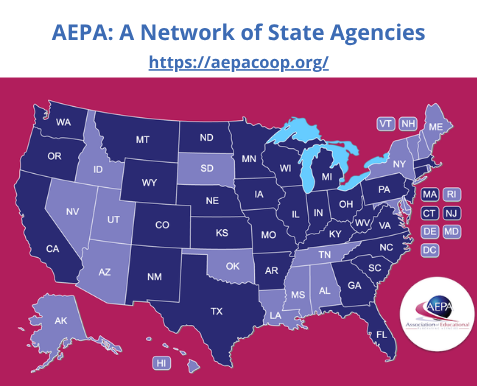
| AEPA | Association of Educational Purchasing Agencies | 26 states | http://aepacoop.org/ |
| Buy Boards | BuyBoard Cooperative Purchasing | TX based, operates nationwide | https://www.buyboard.com/Home.aspx |
| ISDC | Idaho School District Council | Idaho | https://www.idsdc.org/ |
| LTC | Illinois Learning Technology Purchase Program | Over 1,000 public and non-public schools in Illinois | https://www.ltcillinois.org/iltpp/ |
| NCPA | National Cooperative Purchasing Alliance | 14,000+ members (K-12, Higher Ed, Private/Independent Schools, Municipalities) | http://www.ncpa.us/ |
| REMC | Regional Educational Media Center Association of Michigan | Michigan | http://www.remc.org/ |
| SOURCEWELL | Sourcewell | Minnesota, operates nationwide | https://www.sourcewell-mn.gov/ |
| TIPS | The Interlocal Purchasing System | TX based, operates nationwide | https://www.tips-usa.com |
Navigating the ESA Landscape: A State-by-State Playbook
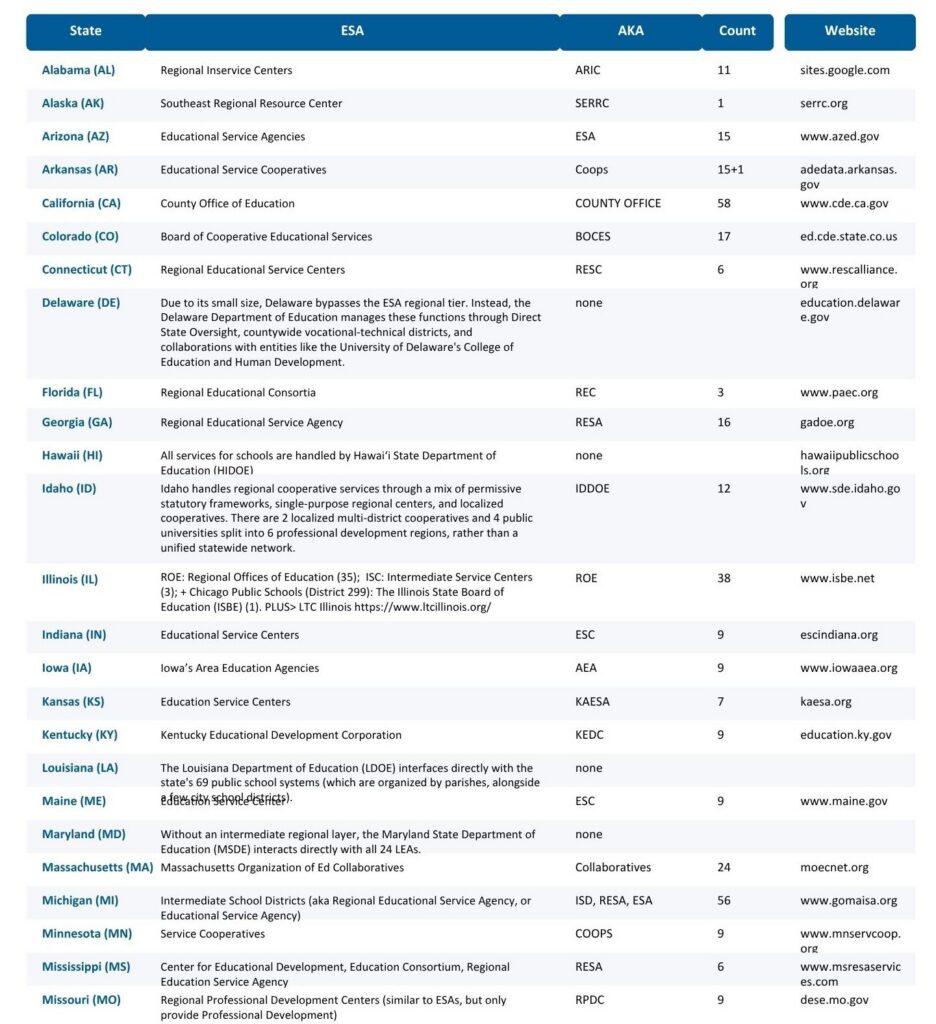
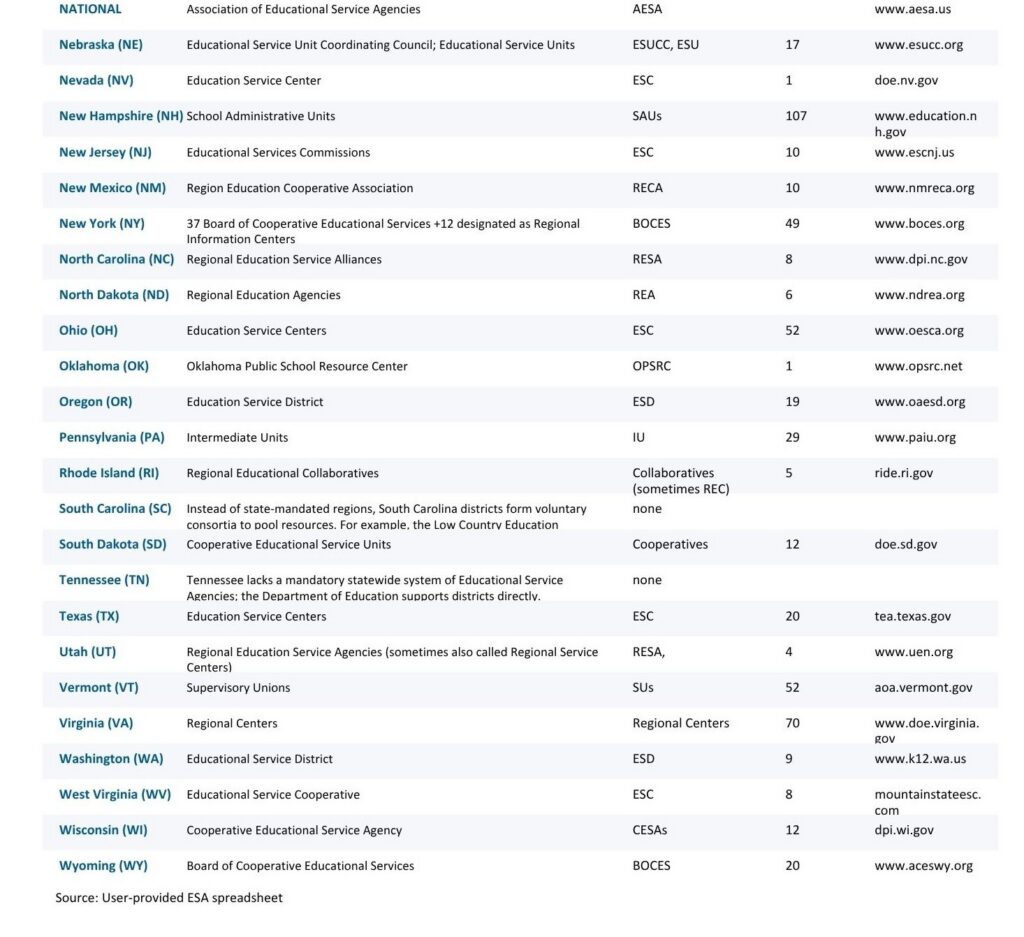
While understanding the high-level role of ESAs is critical, your sales team’s success hinges on their ability to identify and engage with specific agencies within their assigned territories. ESA naming conventions, organizational structures, and fiscal authorities vary significantly from state to state, often even within the same region.
Use the following guide to audit the agencies in your target markets and ensure your sales strategy aligns with the specific regional landscape you are entering or download the list here.

Developing partnerships and working relationships with ESAs enables a savvy solution provider to operate more efficiently in a region leveraging ESAs for a one-on-many sales and support strategy.
Maximizing Impact: A One-on-Many Strategy
Success starts with a deep dive into the specific ESA structures within your target states. Because agency focus areas vary significantly, your team will need to map these regional services to your specific solutions. A prudent practice is to make this ESA landscape analysis a mandatory element of your sales team’s territory business planning.
Successful engagement with an ESA hinges on positioning your company as a strategic partner rather than a vendor. Your objective is to help the agency deliver tangible, value-added services to its constituent districts, making your solution an integral part of their regional strategy. This alignment fosters long-term collaboration; the following are proven tactics are essential for effectively cultivating these relationships.
✓ Lunch and Learns are a highly effective engagement strategy. ESAs are constantly looking to provide their districts with the latest industry insights and best practices. By sponsoring a lunch at a regional meeting, you create an opportunity to present your expertise. It is crucial to position these sessions as problem-solving and thought leadership workshops rather than product pitches. When you focus on helping districts address common challenges, you transform from a vendor into a trusted resource, significantly increasing the likelihood of being invited back to present repeatedly.
✓ Train the Trainer: This is a powerful, low-cost strategy. Instead of sending your own staff nationwide to deliver low-margin professional development, and support, build a plan to partner with an ESA to “super-train” their team. This empowers the agency to champion your solution as part of their regional offerings, aligning it with local standards and initiatives. By focusing your team’s time on supporting these key agency contacts rather than every individual district, you create a sustainable, scalable “win-win-win” for both your company the ESA and the schools.
✓ Last but not least, perhaps one of the best ways to build relationships that foster partnerships with ESAs is to work through the Association of Educational Service Agencies (AESA). AESA is the professional organization serving over 475 member organizations, representing 94% of all ESAs nationwide. Their mission is to strengthen regional ESAs nationwide by advocating for impactful policies, providing professional development, and fostering collaboration through networks and research. There are several key conferences and events each year where partners are welcome to contribute thought leadership informational sessions, network and even exhibit their solutions.
Educational Service Agencies Decoded: A 5-State Comparative Analysis
Consider the differences in five key states: New York, Illinois, Florida, Texas and California. In these states though the ESAs are designed to support local schools, they span a distinct continuum from strict regulatory enforcement to entirely voluntary collaboration. California’s COEs and Illinois’s ROEs serve as powerful local enforcement arms of the state departments of education, with California focusing heavily on strict fiscal auditing and budget takeovers, and Illinois prioritizing facility safety and teacher licensure. Texas’s ESCs lean into uniform administrative and data compliance, operating as massive regional extensions of the state education agency. In contrast, New York’s BOCES and Florida’s Consortia strip away regulatory power entirely; New York relies on a robust state financial matching incentive to encourage districts to cooperatively share classroom costs, while Florida operates a lean, voluntary safety net specifically to give under-resourced rural districts needed economies of scale. The primary differences lie in fiscal oversight powers, geographic structures, and how districts opt into their services.
| Feature | California: COEs | New York: BOCES | Texas: ESCs | Illinois: ROEs / ISDs | Florida: Regional Consortia |
| Geographic Boundaries | Strict county lines (58 total). | Regional clusters of districts, ignoring county lines (37 total). | Large geographic regions spanning multiple counties (20 total). | Based on county lines, but many smaller counties are consolidated (35 ROEs + 3 ISCs). | Spans multiple small, rural counties. Built specifically around the state’s 3 designated rural zones. |
| District Membership | Mandatory. Every district belongs to its county’s COE. | Optional for independent districts (though most join). | Mandatory geographic placement; services purchased via co-ops. | Mandatory. All public school districts are mapped to a regional office. | Strictly Voluntary. Designed explicitly for small, rural districts (under 24,000 students) that choose to join. |
| Fiscal Regulatory Power | High. Power to reject local budgets and intervene in insolvency (AB 1200). | Low/None. Acts as a supportive partner, not a fiscal regulator. | Moderate/Low. Focuses on compliance monitoring for the state agency. | Moderate. Reviews financial statements and checks “Life Safety” facility codes. | None. Completely non-regulatory. They possess no regulatory teeth or taxing authority. |
| Leadership | Mostly elected County Superintendents and Boards. | Board members elected by component local school boards. | Board of Directors selected by local boards and approved by the state. | Elected Regional Superintendents of Schools (political office). | Governance Board composed of the Superintendents of the actual member school districts. |
A Unicorn Amongst ESAs — New York BOCES (37 + 12 RICs)
To succeed in New York’s education market, vendors must engage with the 37 regional Boards of Cooperative Educational Services (BOCES), which support an array of services including: professional development, special education, instructional support, facilities/operations, and vocational programs, and the 12 independent Regional Information Centers (RICs) that specialize in technology and data services. A key advantage of the BOCES model is its ‘Cooperative Services’ agreements (CoSers), which bundles products with value-added services and that provides school organizations with significant state aid, sometimes exceeding 50%, making solutions highly cost-effective and attractive, particularly for high-poverty districts. Vendors should conduct grassroots marketing to generate regional demand, build partnerships with agency staff, and leverage streamlined statewide procurement processes, such as those established by ERIE 1 BOCES, to effectively scale their reach.
Executive Takeaway: ESAs Unlock the Power of Regional Partnerships
Thus, Educational Service Agencies (ESAs) serve as a critical, often underutilized, infrastructure within the U.S. K-12 ecosystem, acting as a vital bridge between state objectives and local school needs. With approximately 904 agencies nationwide managing over $15 billion annually, ESAs provide essential services ranging from cooperative purchasing and grant management to specialized instructional support. For providers, success in this market requires moving beyond a transactional vendor mindset to build long-term, strategic partnerships. Leveraging ESA purchasing consortiums to streamline procurement and collaborating with agency staff for professional development, companies can achieve a scalable “one-on-many” growth strategy that effectively meets the diverse, regionalized requirements of the American school system.